Registered scan appearance: bounded browser control
This is a same-source workflow control, not an independent scan-to-BIM accuracy claim. It uses the public textured boulder GLB and a previously authored IFC capture of the same geometry. Source provenance and the original full-surface alignment control are recorded in scan-alignment-workbench. The source has 66,122 triangles. This run explicitly creates and selects a 350-triangle destination; no scope reduction happens inside transfer.
Reproduce the interaction
- Open the captured IFCZIP, then Add
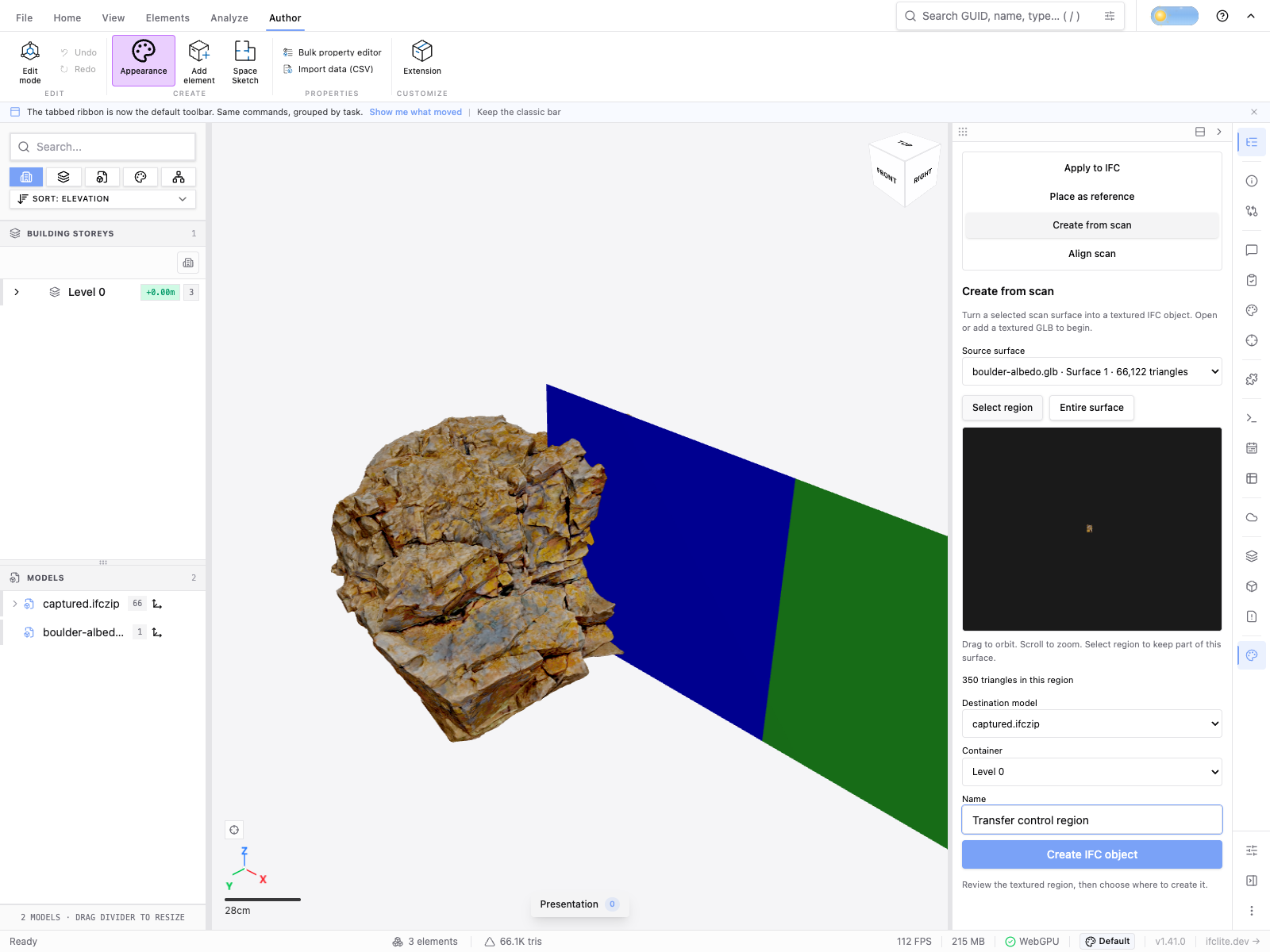
boulder-albedo.glbthrough the canonical loader. Fixture content hashes and actual browser/WASM versions are in runtime.json. - In Author → Appearance → Create from scan, choose the GLB surface and Select
region. The rectangle runs from
(0.48, 0.48)to(0.50, 0.515)of the default preview canvas. Create Transfer control region. declared-region.png shows the explicit through-surface region; both front and back triangles remain. - Use the existing Apply to IFC action to give that selected object an 8×8
solid-blue PNG (
#1746df). This makes retained unknown appearance independently distinguishable from the brown scan image. Other IFC objects remain unchanged. - Hide the GLB in the main view and open Align scan. For this known same-source
control only, arrange the main camera using the actual source preview camera
and the fixtures' known translation. Pick four fit and four independent check
pairs through normal preview/main-view clicks. No observations are injected.
The recorded good.json retains triangle/barycentric identities and
the native request/report. Normalized preview click positions are
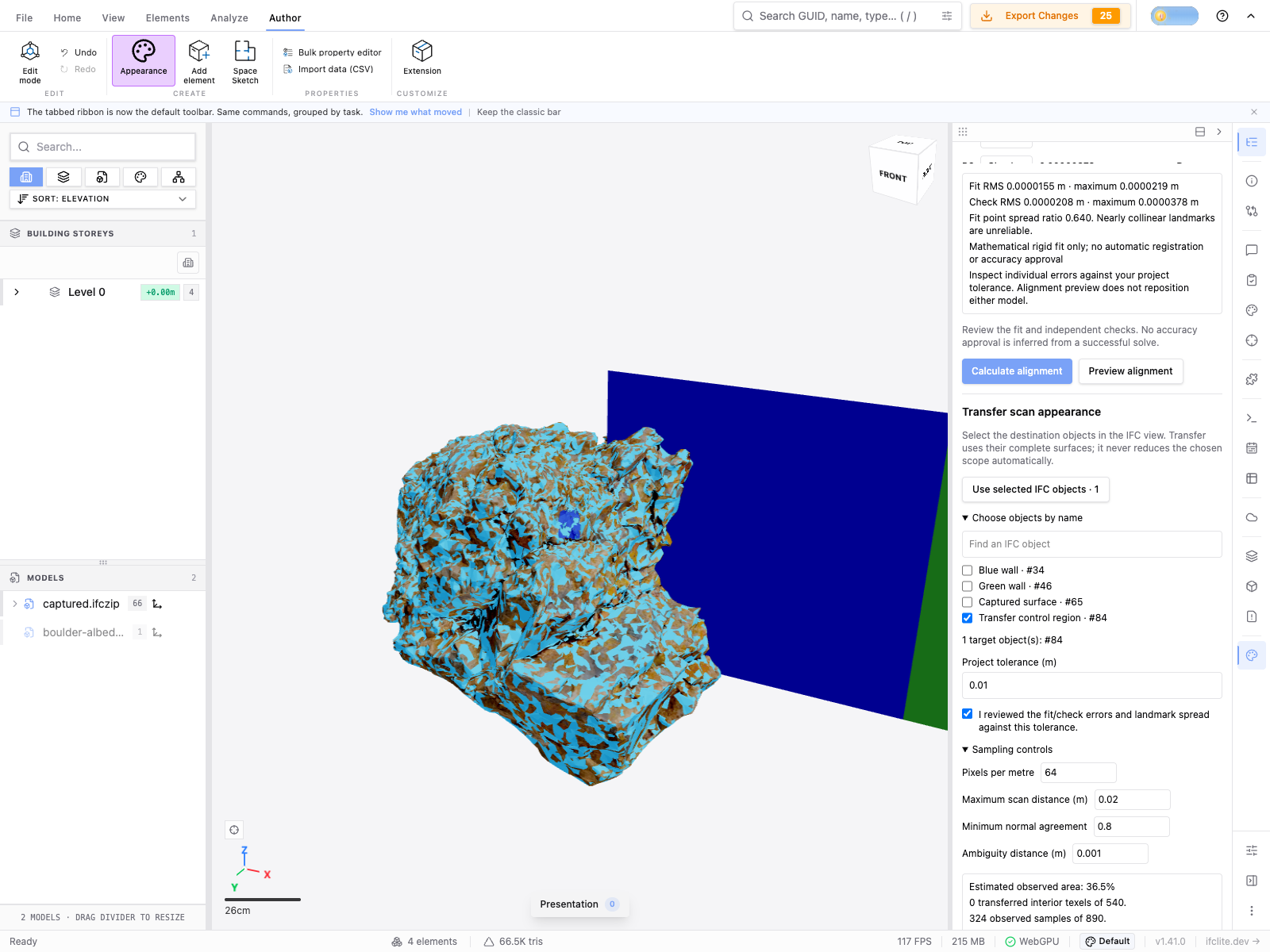
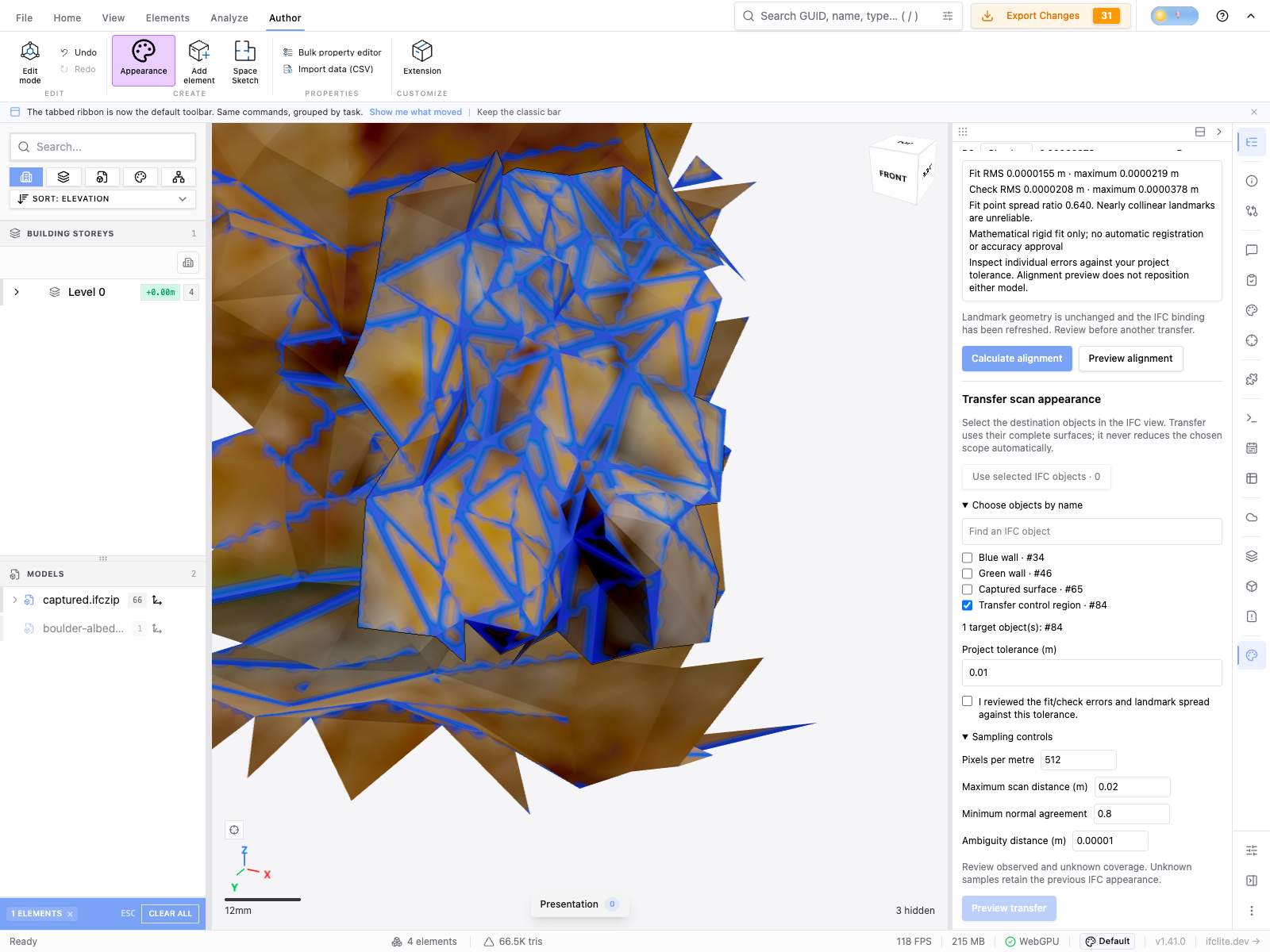
(0.40,0.45),(0.58,0.44),(0.43,0.62),(0.58,0.64),(0.48,0.40),(0.38,0.54),(0.53,0.47),(0.49,0.53). - Choose Transfer control region in the searchable target list. Review the fit/check errors and spread against a 0.01 m project tolerance.
- First preview at 64 pixels/m, 0.02 m maximum distance, 0.8 normal agreement and 0.001 m ambiguity distance. sparse-no-apply.png shows 0/540 transferred interior texels, despite 324 observed diagnostic centroids. Apply is absent. The native paired regression separately proves that the former sparse atlas contained only old blue pixels.
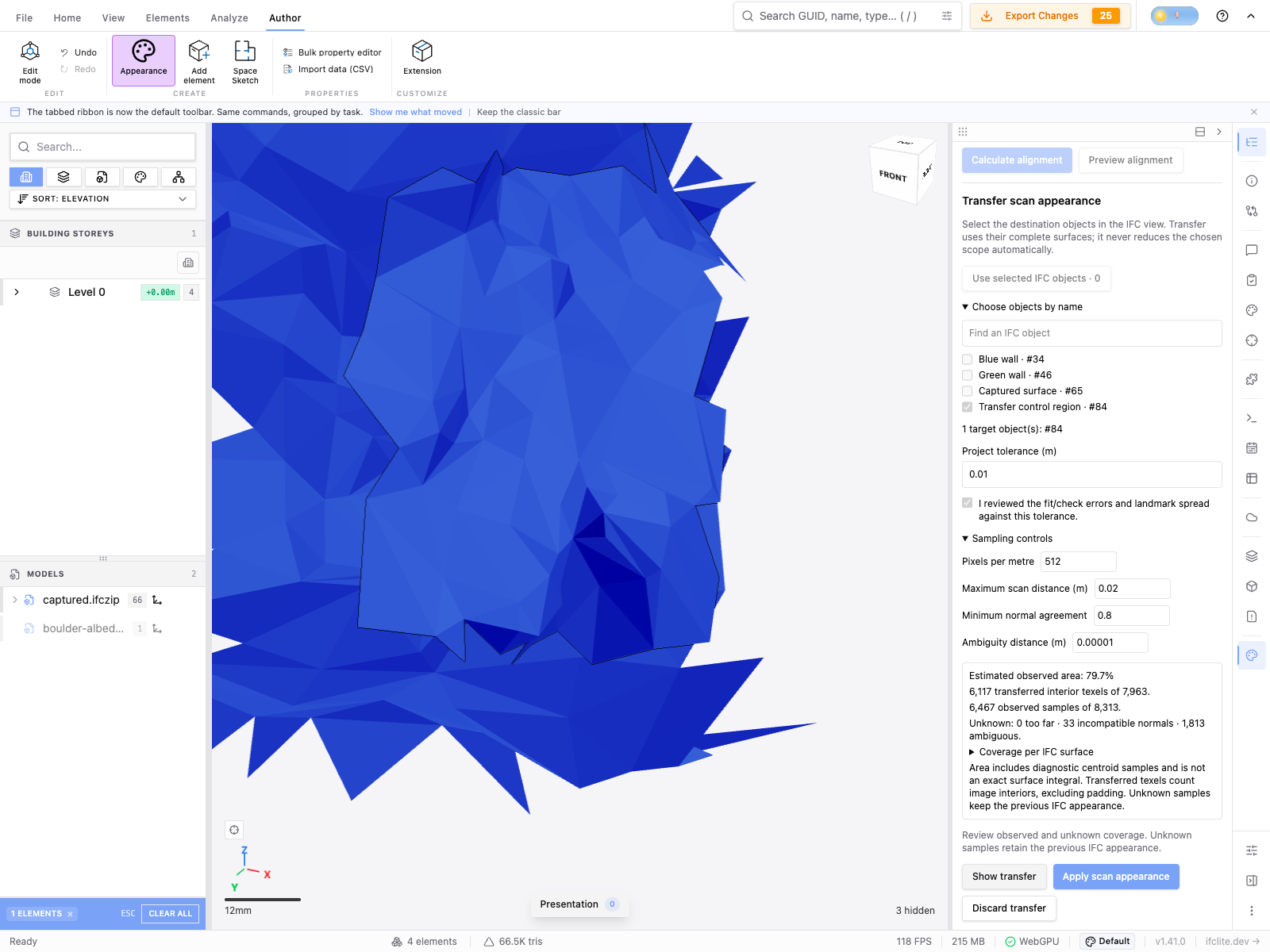
- Explicitly change sampling to 512 pixels/m and 0.00001 m ambiguity distance; leave the other settings unchanged. Preview reports 6,117/7,963 observed interior texels, with an estimated observed area of 79.7%.
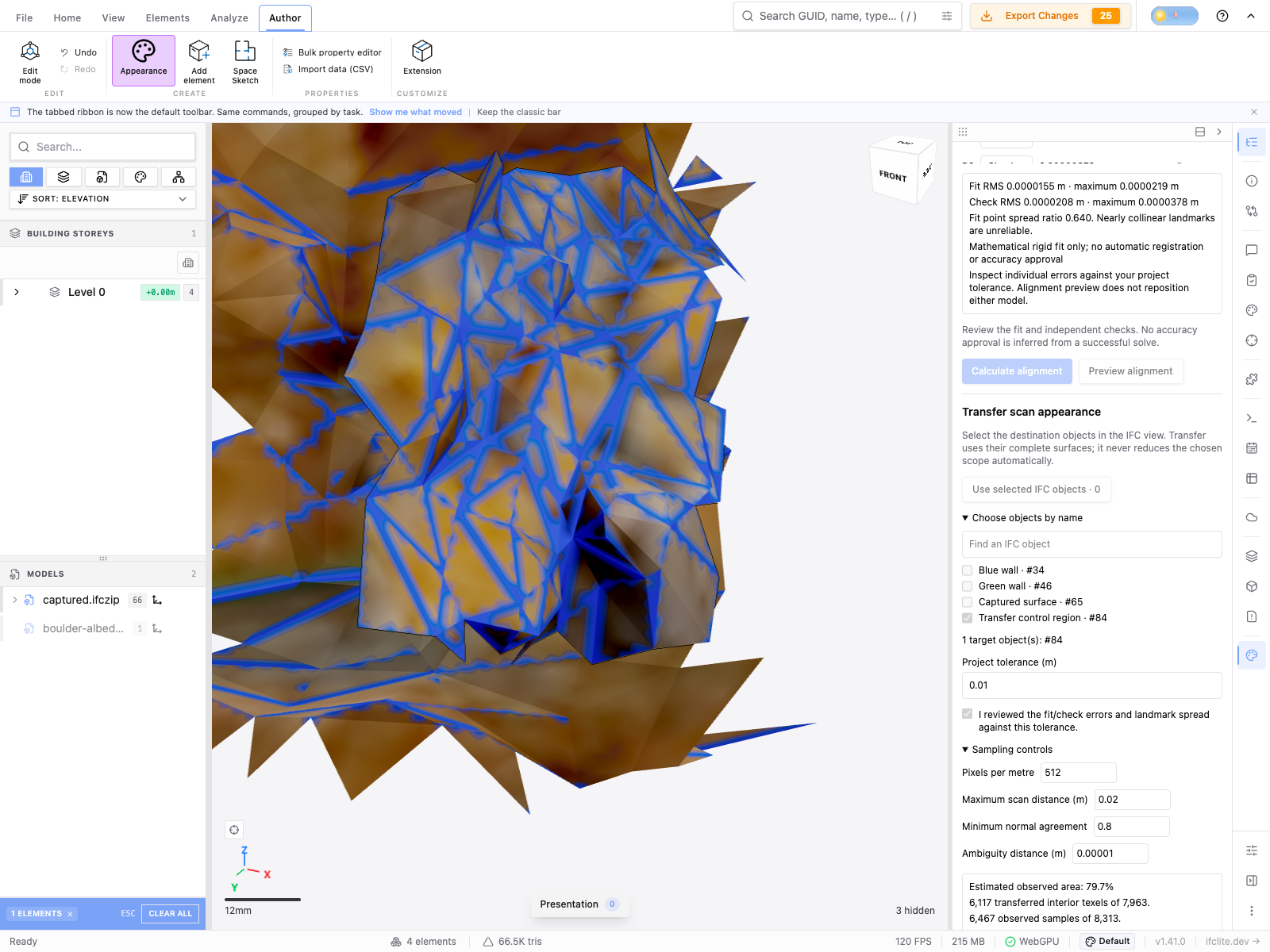
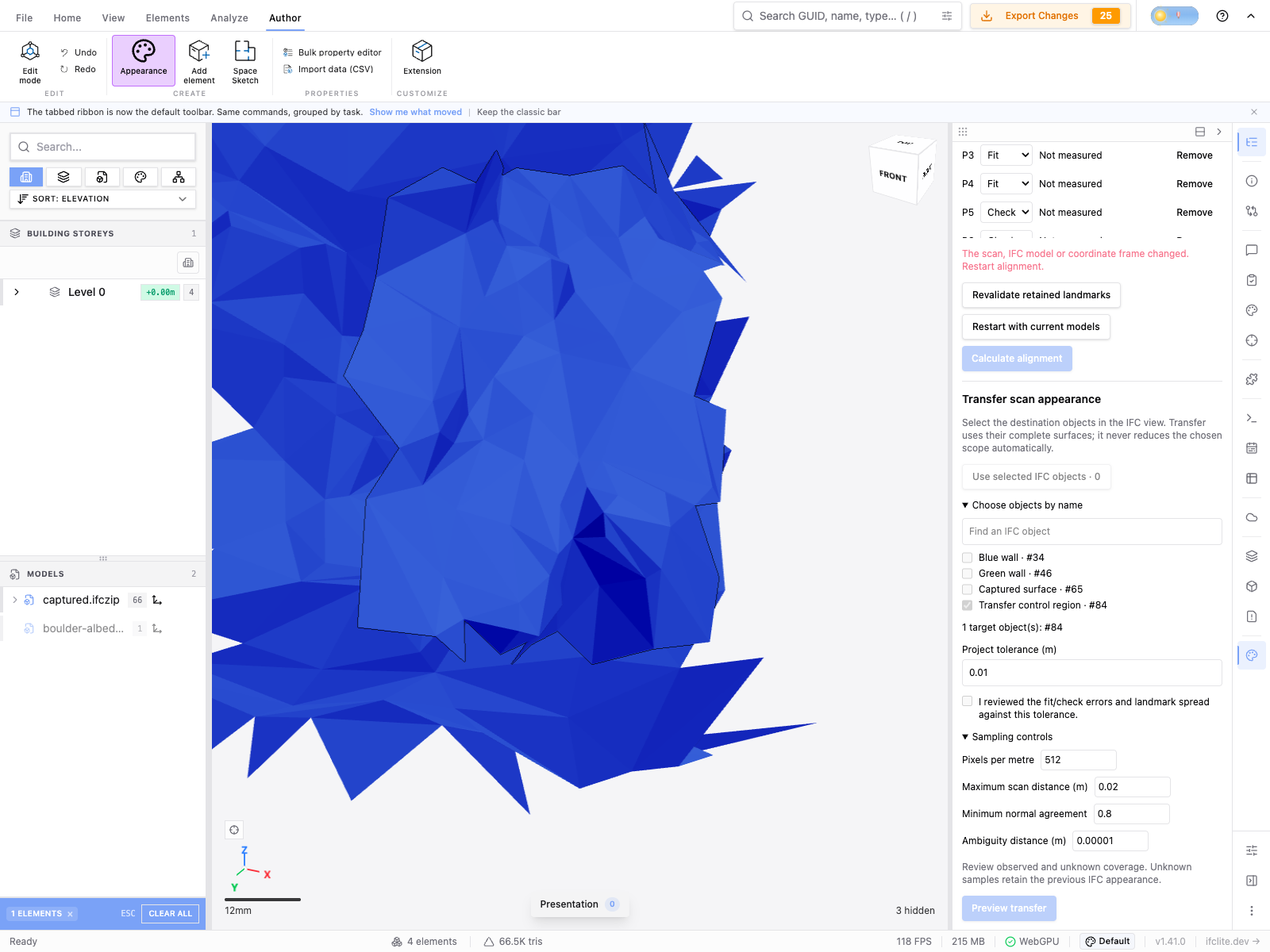
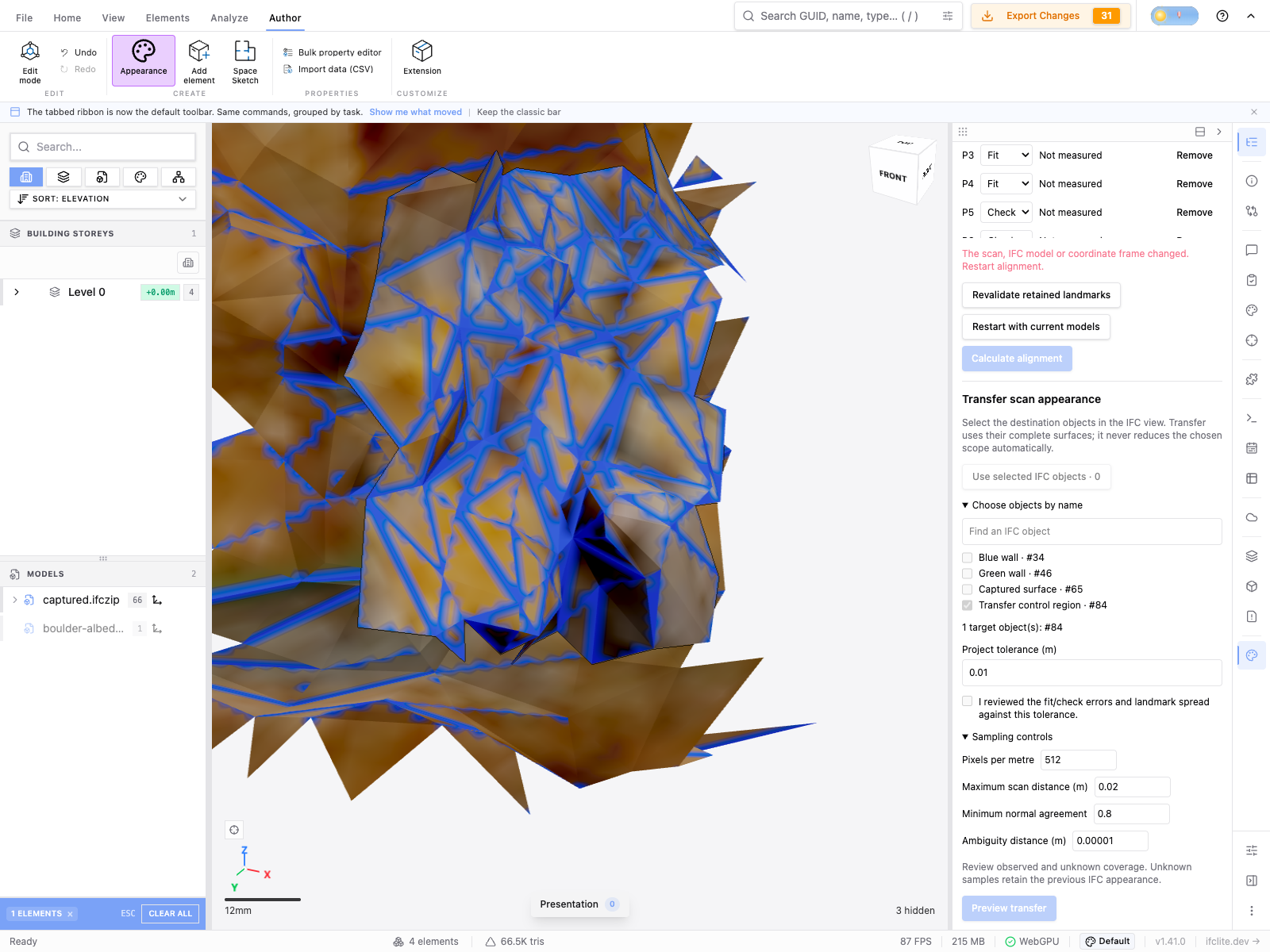
- Isolate the chosen owner through canonical visibility state for this controlled comparison, select it with an actual canvas click, and use the ordinary orthographic projection, Frame and wheel controls. Compare the same view: original blue and transferred appearance. Brown scan pixels and blue unknown boundaries are visibly different. These conservative seams and partial coverage are deliberate retained-appearance behavior, not a claim of seamless texture synthesis.
- Apply. refreshed.json retains all eight pairs and a new native digest against the changed effective IFC. Undo and explicitly Revalidate retained landmarks; Redo and revalidate again. Export through the ordinary IFCZIP dialog. applied.png, undo.png, and redo.png record that history journey.
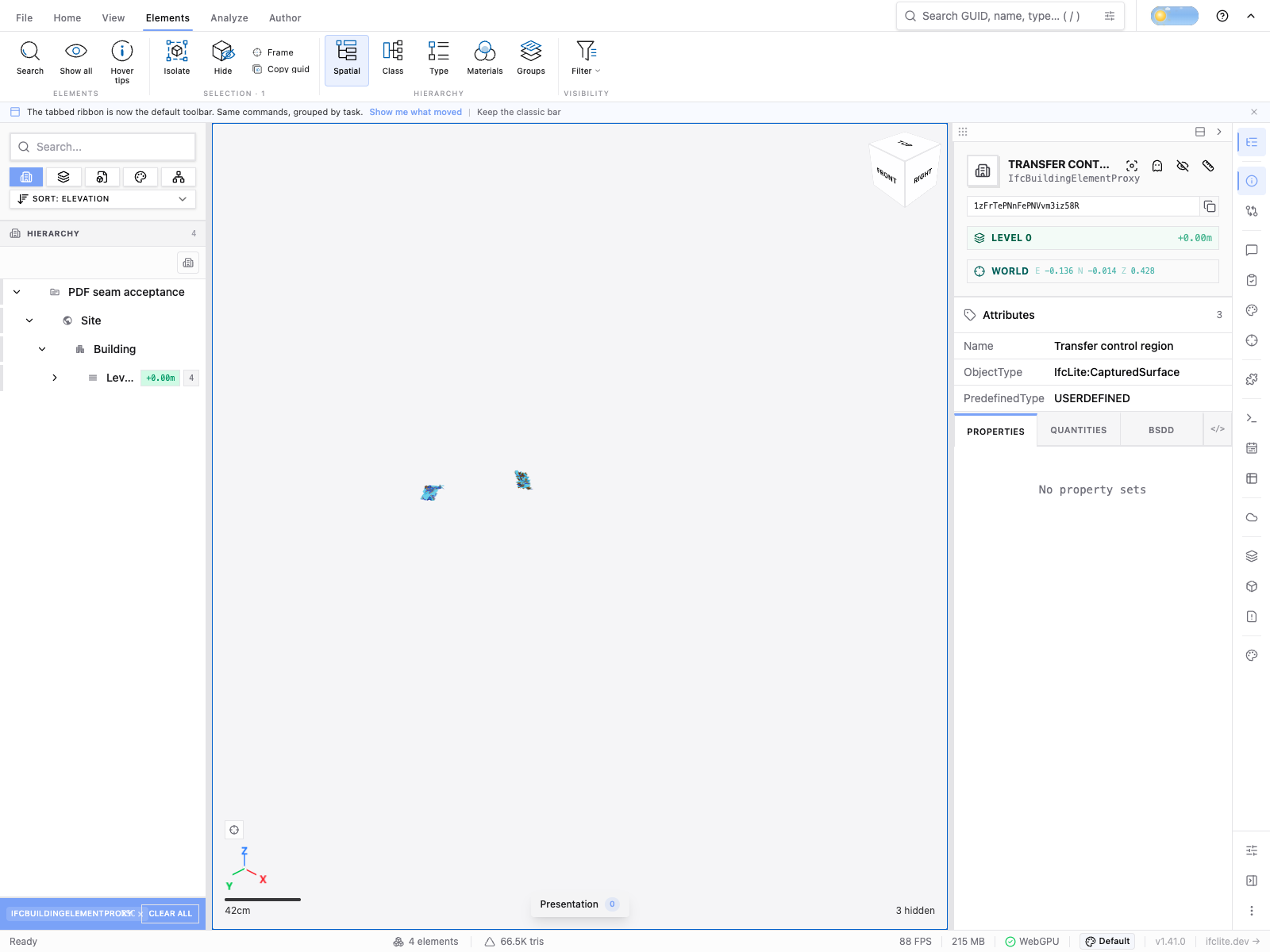
- Open that IFCZIP in a fresh browser, isolate the region through canonical visibility state, and select it with an actual mouse click. The reimport witness and reopen-proof.json record the selected owner, texture, triangle count and decoded-pixel digest.
Independent export checks
ifc-oracle.json records an IfcOpenShell 0.8.2 inspection of the
exact pre-Apply IFC and exported IFCZIP. The destination's coordinate list,
triangle indices and placement are unchanged. Every reopened triangle corner
matches the exported IFC world position and its associated native V-up UV after
one flip to GPU V-down. Maximum discrepancies are about 7.3e-8 m and 4.45e-8
UV units, within the expected Float32 representation.
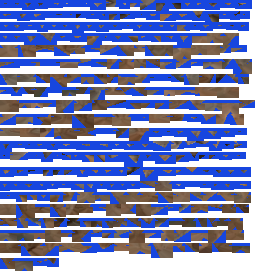
All decoded atlas pixels match the fresh browser bitmap exactly. The exported 256×271 PNG contains 21,970 opaque non-blue pixels and 25,230 retained-blue pixels; those counts include atlas padding and must not be confused with the native interior-texel coverage counters. exported-atlas.png is the actual exported image. The original scan JPEG remains in the IFCZIP for the untouched full-surface object.
Verification and limits
validation.json records exact input/output hashes and local checks. The six changed-test groups pass all 31 tests on Node 22.23.2 through root Turbo: mounted cancellation/settings/stale/removal, geometry rebind guards, actual native transfer and PDF envelopes, rotated IFC parent plus unequal rebases, worker ownership and snapshot fencing. Root typecheck, full build, lint, API/module/license gates and documentation checks pass.
The broader Node 26 viewer run has 7,668 passing tests, 12 skips and one existing
registry failure: layerStackSlice was both registered and exempt. That defect
was fixed independently by #4425 (closing #4424). After merging that fix, the
final Node 22 registry shard passes all six tests. The original broad run is
not relabeled as a passing full suite.
Build graphs and final acceptance runs were separated. Chromium and owned dev
servers are closed after acceptance.
The control does not validate independent surveyed registration, RGB-point or posed-photo transfer, general scan reconstruction, arbitrary full-model capacity. Those remain #4381 and future-adapter acceptance. Room portability acceptance subsequently verified sharing and room export of this exact transferred IFCZIP. The existing native work/memory limits remain active; the full boulder target is not silently substituted for this explicitly selected small region.