Transferred appearance through Share and room export
This browser acceptance uses the actual transferred.ifczip produced by the
350-triangle transfer control. It verifies
portability of the applied scan appearance, including retained blue unknown
regions. It does not establish independent registration accuracy or larger-model
transfer capacity. Issue #4381 remains open for those and RGB-point adapters.
The viewer and relay were built from main 8a962988e with Node 22.23.2. A fresh
local relay used an in-process random signing secret; no production room or
existing invite was used. Runtime and artifact hashes identify
the exact inputs. The full root build passed all 51 tasks. No product code changed.
Journey and measured results
- Open the transferred IFCZIP through the normal file input. The model has four meshes and 66,476 triangles, including the 350-triangle Transfer control region.
- Use File → Share, then navigate the owner into the generated local signed room. The connected owner can select the transferred object.
- Open the link in a fresh browser context. The guest selects the same object.
- Close both contexts, open a new context and rejoin. The transferred object remains selectable.
- Use the normal room export dialog, save IFCX, and open it normally in another fresh context. The reopened IFCX retains the selected object.
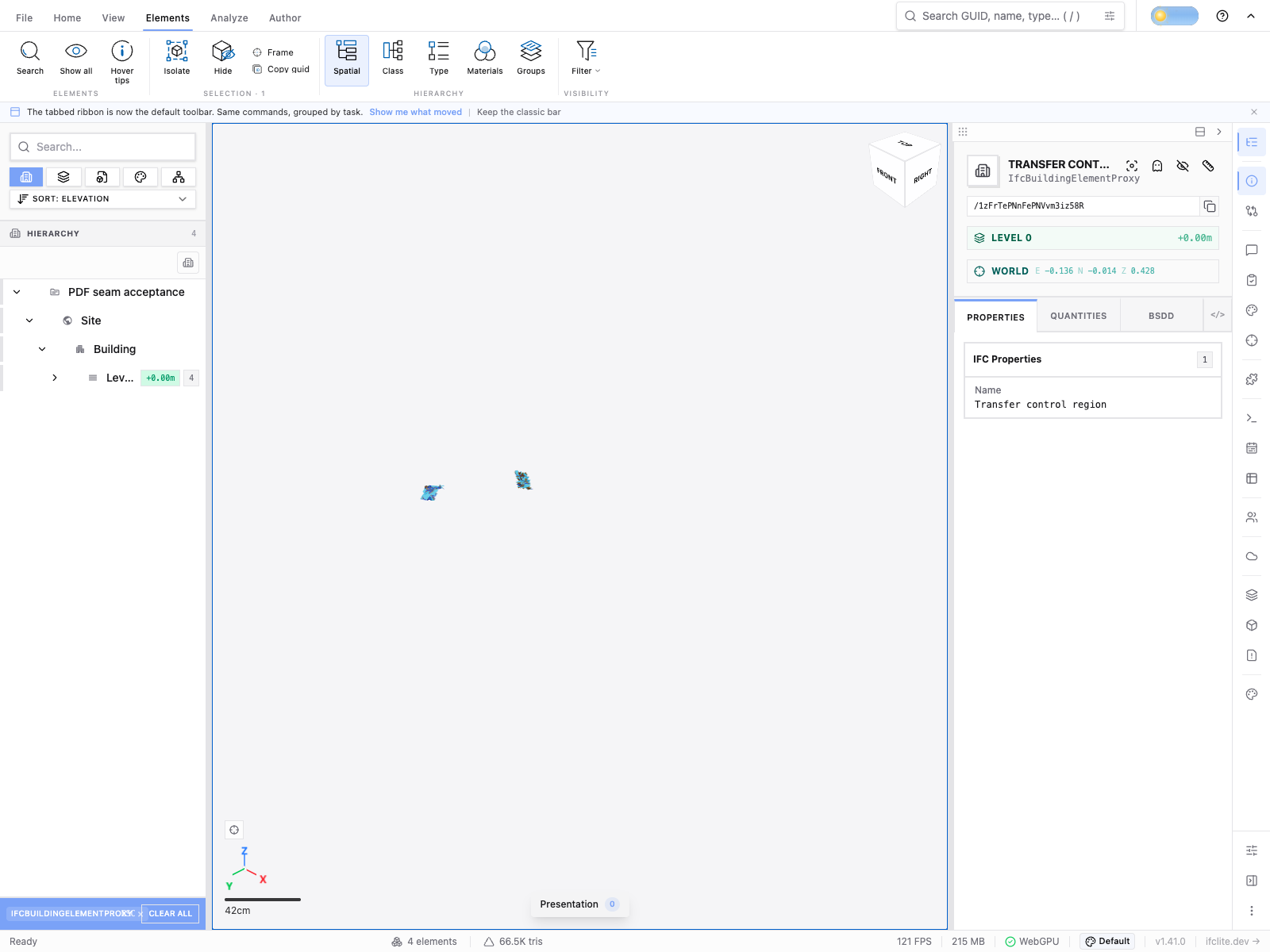
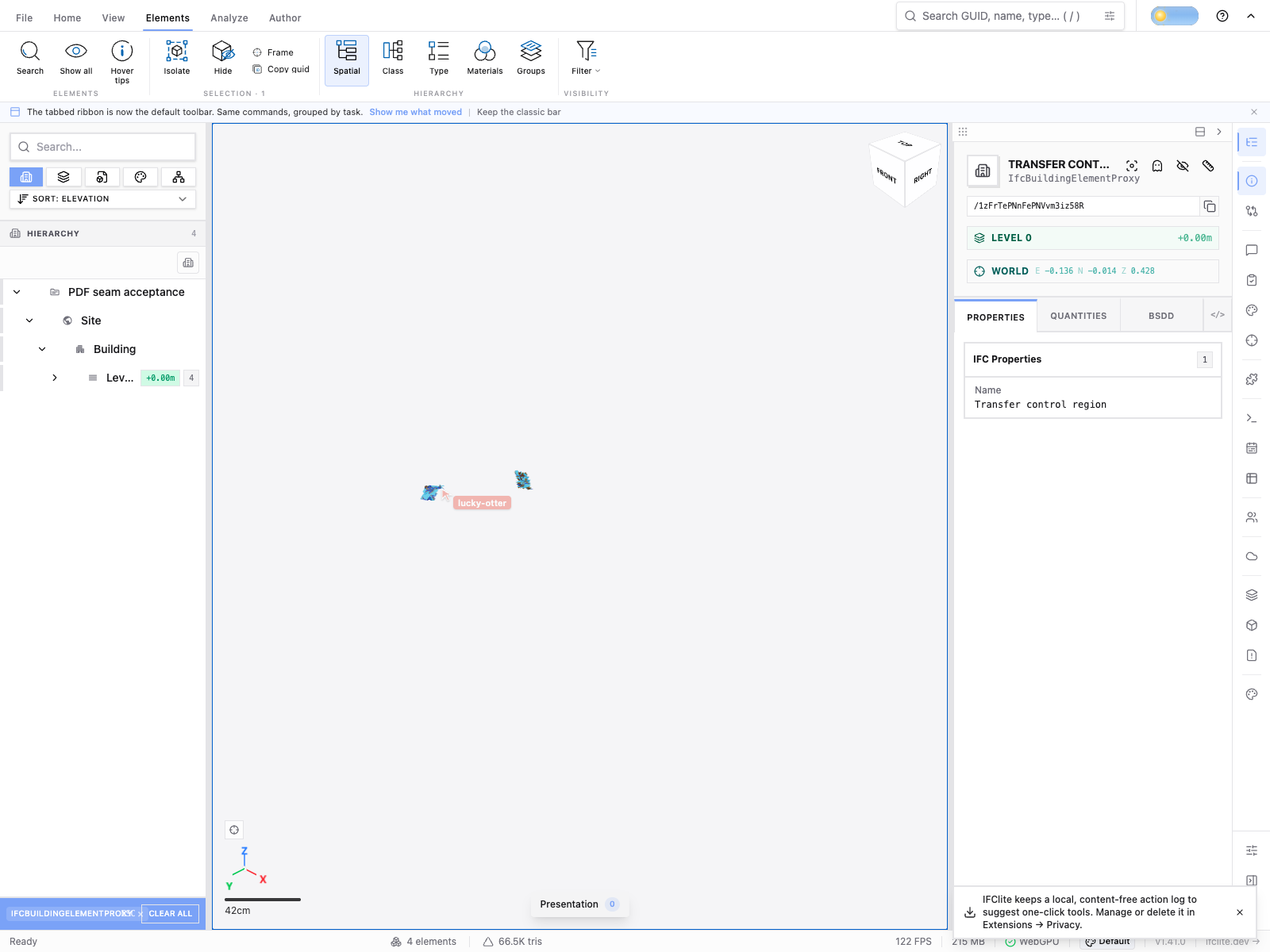
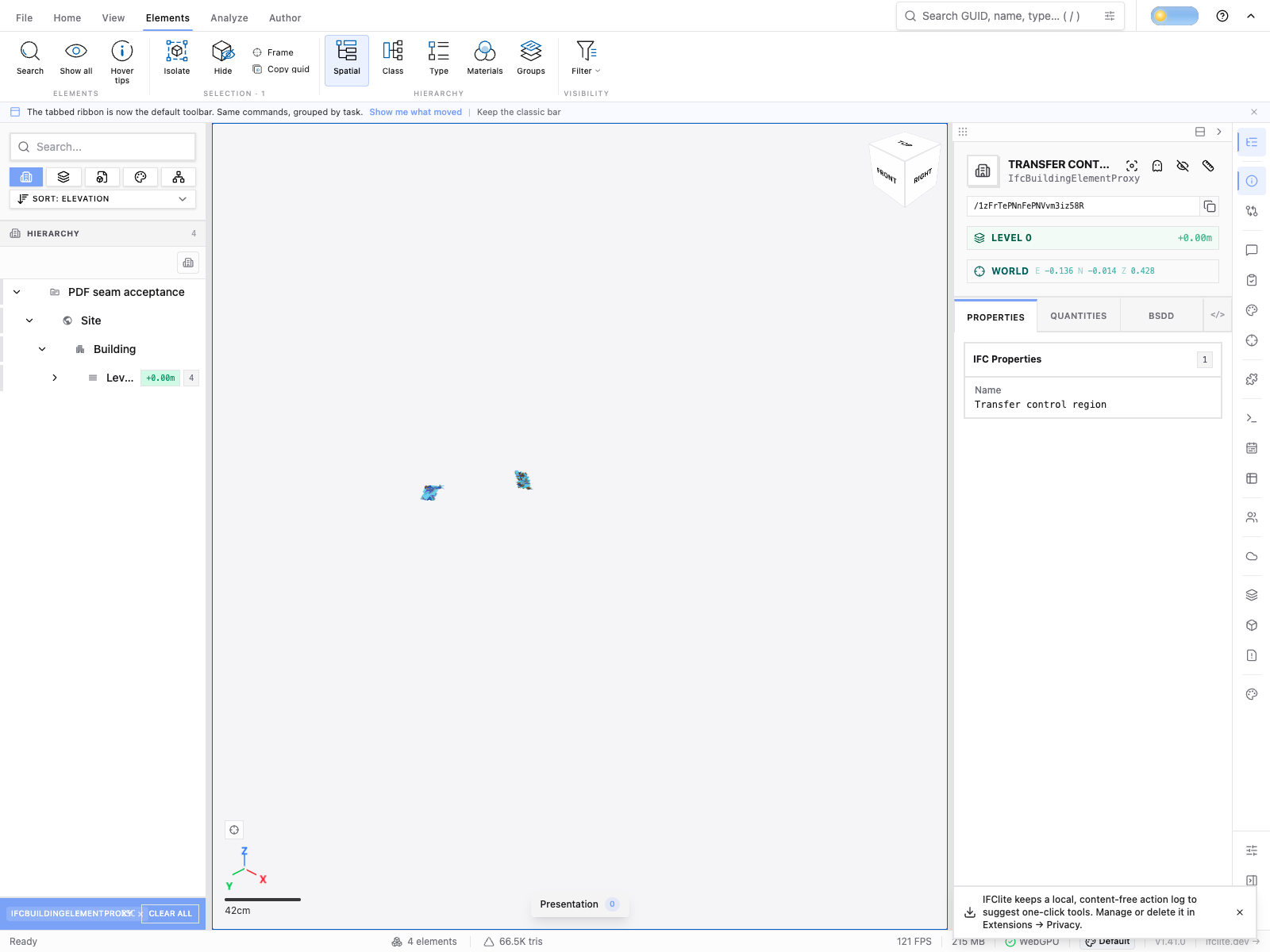
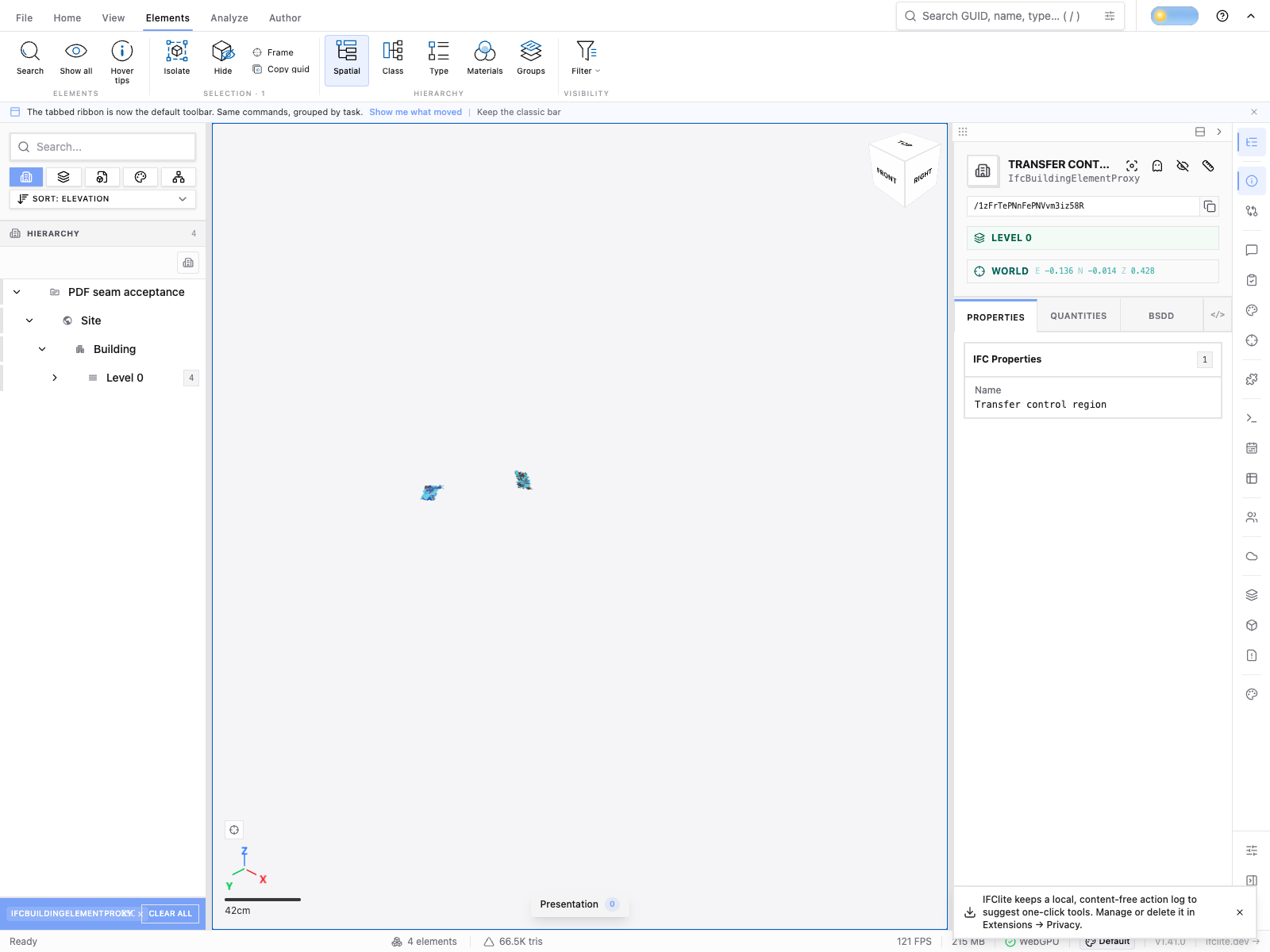
Each selection uses a real mouse click on a projected triangle inside the main viewer canvas after explicitly isolating the target. Isolation is cleared before sharing or exporting, so the exported scope remains all four meshes. Screenshots show the selection and properties; the earlier transfer control supplies the close appearance comparison.
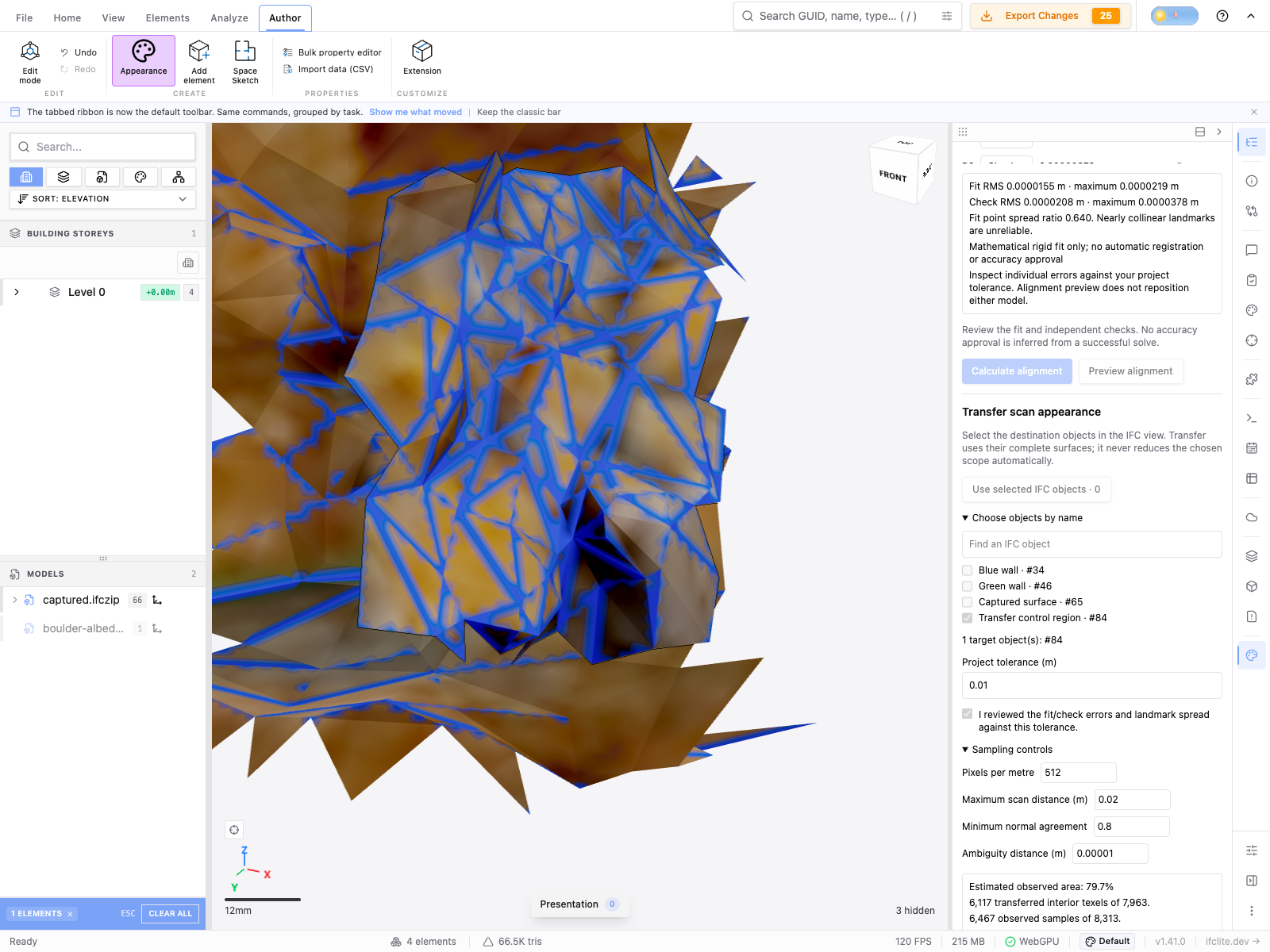
Recorded comparisons check every oriented corner of all 350 target triangles in world coordinates and its associated UV. Owner room, guest, rejoin, and reopened IFCX all have zero measured world-coordinate and UV differences against the original loaded IFCZIP, with unchanged non-repeating sampler flags. Numeric entity IDs change across room/import boundaries; the checks identify the textured target and record its corresponding IFCX path rather than assuming IDs are portable.
The 256 × 271 atlas is compared independently: Pillow decodes the original PNG from IFCZIP, while the exported IFCX supplies embedded RGBA. All 277,504 bytes match, including observed scan pixels and retained blue unknown pixels. Pixel proof records the SHA-256. Room transport preserves decoded appearance; this is not a claim that it preserves the original compressed PNG or JPEG bytes.
The disposable browser contexts, viewer server and relay were stopped after acceptance. Large model files, raw geometry snapshots, relay data and signed links are excluded from this evidence directory.