Full selected-target scan transfer (#4381)
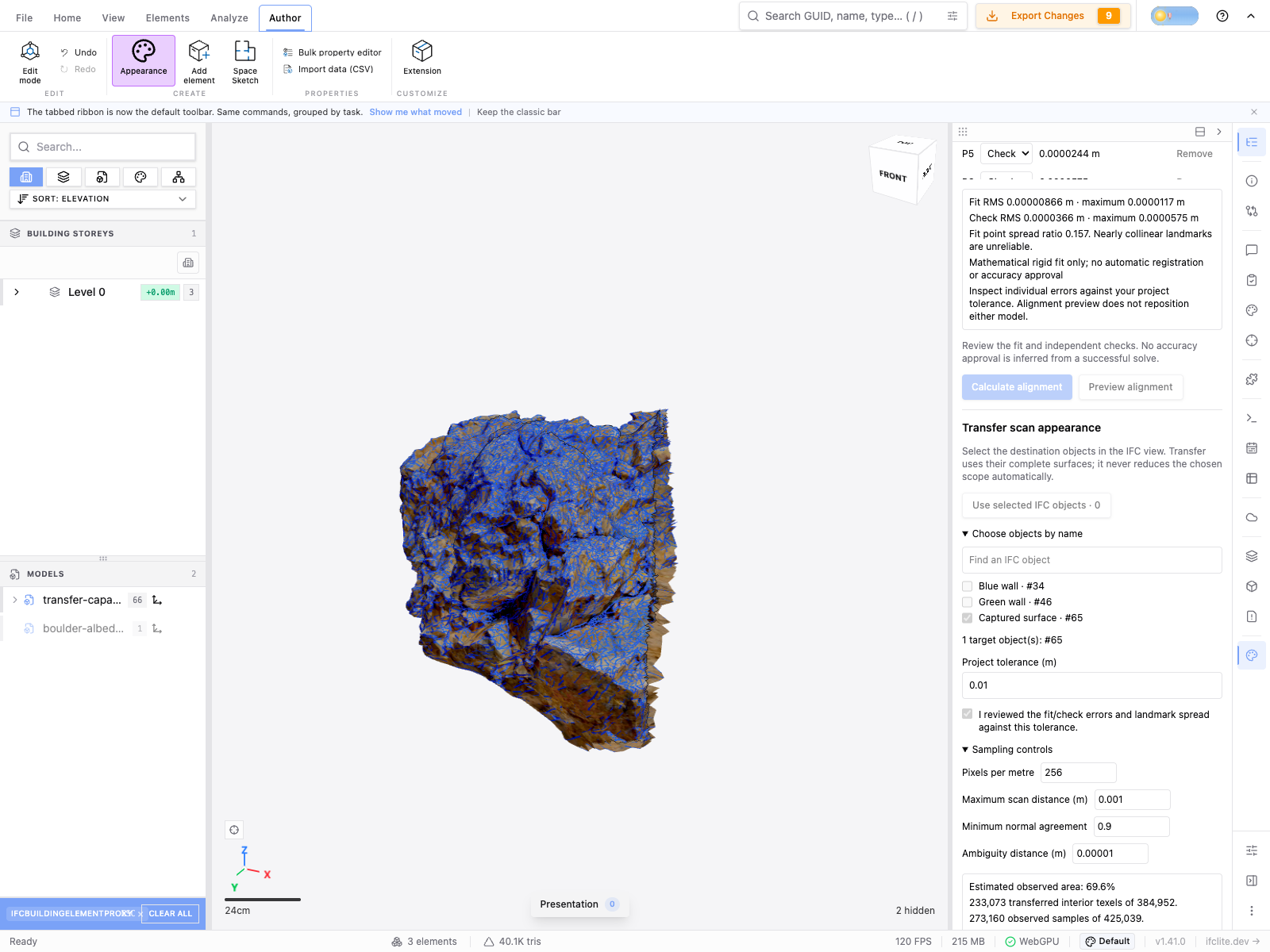
The complete selected boulder owner (40,087 triangles) now produces an applicable appearance plan against all 66,122 source triangles. The two unselected wall controls remain outside that explicit scope. This is a known-derived capture control, not independent real scan/BIM registration evidence.
Mechanism and limits
Nearest-first BVH traversal shrinks the query radius after exact primitive measurements and retains the complete nearest-distance ambiguity band. Normal rejection still follows geometric-nearest selection; a farther favourable normal cannot replace an incompatible nearer surface. Transfer chart padding inherits the nearest interior texel within its own chart. Interior unknown texels remain unchanged, padding never counts as observed coverage, and a subpixel chart with no interior retains its old appearance. The ordinary image/page shader keeps its existing behavior.
The aggregate transfer work allowance changes from 64 million to 128 million units. Scan-owned memory accounting remains 256 MiB and reserves the padding scratch space before allocation. This is an explicit capacity change combined with a different algorithm; the earlier experiments' refusal at 64 million remains valid. Raising the work allowance alone still refused the full target. A tripled overlapping source with 198,366 triangles refuses the memory budget; there is no applicable output. The viewer also refuses this target at density 512 under the same memory limit. It never silently reduces the requested scope or density.
Browser and independent-reader acceptance
The normal viewer imports the capture IFCZIP and the CC0 Poly Haven boulder GLB through the canonical loader. Four actual fit clicks and four held-out clicks qualify the derived control. A blue appearance is applied first to make retained unknown appearance visible. At density 256, the complete selected owner passes Preview, Compare, Apply, toolbar Undo/Redo, ordinary IFCZIP export, fresh normal import and actual mouse selection. The raster has 384,952 interior texels, of which 233,073 are observed. Remaining texels keep the prior appearance; this is conservative appearance transfer, not seamless texture synthesis.
Independent IfcOpenShell 0.8.2 results compare every oriented triangle corner and UV against the fresh viewer import. IFC coordinates, indices and placement are unchanged. The decoded atlas pixels match the fresh browser exactly. Preview and fresh selection show the actual generated result. Browser/source identifiers are recorded in browser-runtime.json; its checkpoint includes the candidate runtime integrated with the reviewed PDF-fill and authored-owner prerequisites.
Shared-room portability
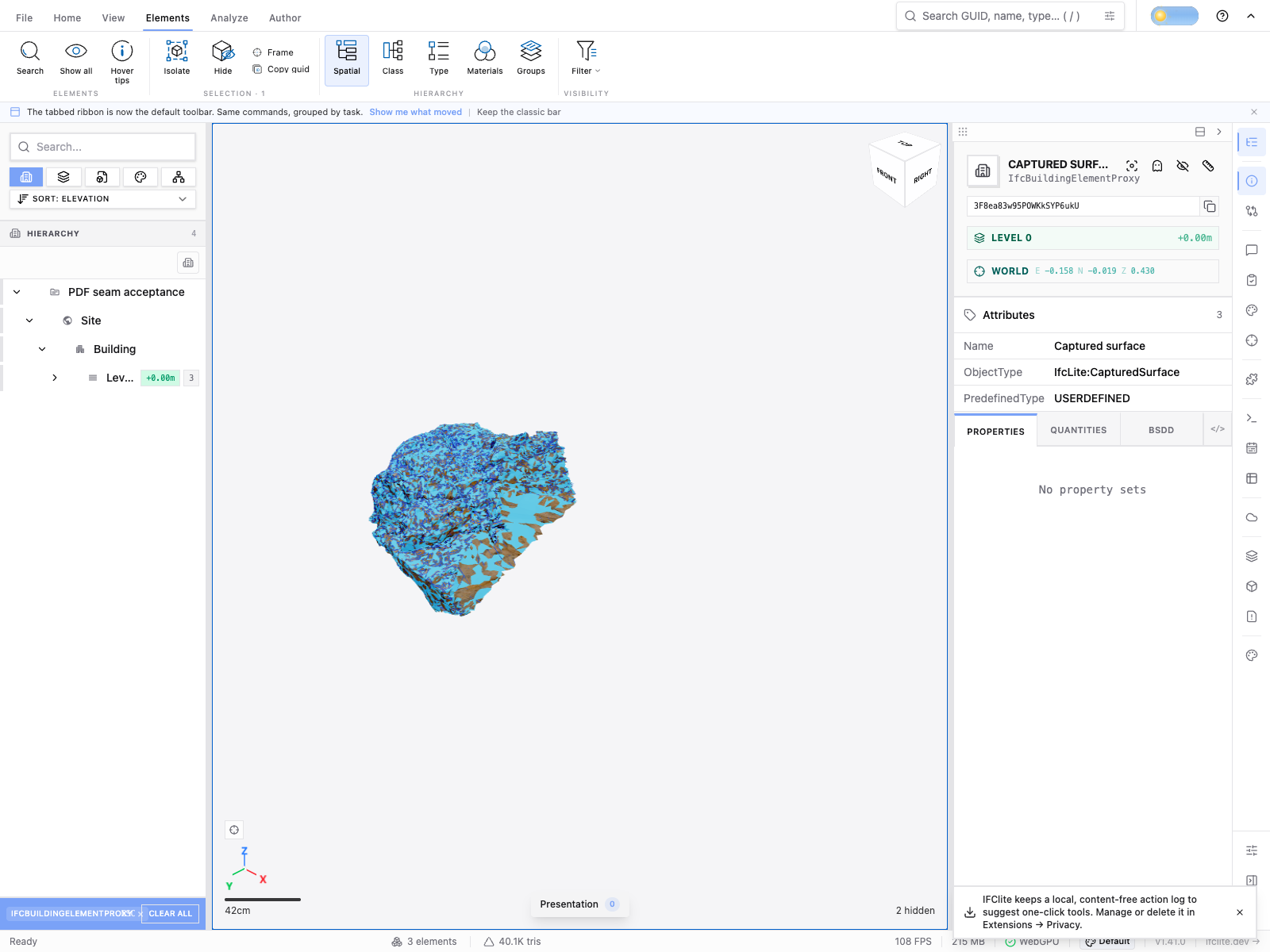
The complete room journey opens the transferred IFCZIP, uses normal Share, joins as owner and as a fresh guest, closes both contexts, then joins in a fresh context. Each state retains every oriented world/UV corner, decoded image pixels and sampler settings. The room exports IFCX through the ordinary export dialog; a fresh normal reopen retains all parts and actual mouse picking. The relay is an isolated local authenticated server, not a production user room. The test waits for initial seed completion before following the link; the separate premature-share-readiness issue #4446 is not claimed fixed here.
Worker capacity measurement
worker.json records five fresh Chromium browser/context/module workers on an otherwise idle machine. Every run returns identical complete IFPA bytes, with an applicable plan and PNG assets. These worker controls use the original target appearance and request, distinct from the blue-background viewer journey; their coverage and atlas hashes must not be pooled. The report includes API-call time, worker/roundtrip time, linear-memory high-water, heartbeat gaps and sampled browser process-tree RSS. RSS includes input, JavaScript and browser overhead, may double-count shared pages and is not an exact peak allocation. Worker termination call latency is not operating-system reclamation latency. This is one machine/model and a complete worker operation, not a worker-pool throughput speedup or full Apply/export latency claim.
The overlap refusal is an actual WASM invocation. Its elapsed time was collected during other work and is not a performance result.
Ordinary-load regression check
Interleaved base/branch native samples compare the exact current-main native source with this candidate on AC20. The first candidate pair is slower and the second pair matches the baseline's reported phase timings; ordered mesh fingerprints and counts are identical. This establishes no consistent regression in these paired controls, not zero overhead. The transfer worker measurement above is separate and makes no worker-pool speedup claim.
Validation
Validation summary: root build/typecheck, complete native workspace, strict Clippy, real WASM contracts and fresh Python wheel parity. The focused large-coordinate primitive/BVH invariant protects the anchored closest-distance calculation against a false nearest/ambiguity classification. Independent review found no remaining blocking runtime finding. The normal image/page path retains its existing shader behavior.
Reproduction
Use the qualified CC0 input and captured target described in
the earlier capacity evidence. Generate
its bounded JSON payload with tools/texture-authoring/boulder-transfer-probe.py.
Build the candidate WASM using scripts/build-wasm.sh, then run:
node tools/texture-authoring/transfer-capacity-worker.mjs \
  /path/to/checkout /tmp/transfer-input.json /tmp/worker.json
The harness owns and closes its browser/server/worker handles, permits only
fixed loopback routes and bounds file reads. It never publishes an IFC mutation.
For native metadata/refusal inspection, split the payload into source.ifc,
request.json, and decoded rgba.bin, then use the transfer_capacity_probe
processing example. No large third-party model is committed.