Explicit federation scope — two copies of one file in one room (#4444)
Two runs: the real-browser journey of the issue's reproduction (owner → fresh
guest → rejoin, two Chrome profiles over a signed relay), and the headless
real-fixture run that preceded it. Both use the real Archicad IFC4
AC20-FZK-Haus.ifc (SHA-256
ea6f04eaf92fac4d7ad0038bc3d2dfea4c094dd3f516ecc33c50bf1835ca108d), loaded
twice so that every IFC identity collides on purpose.
Browser run (2026-09-12)
tests/e2e/collab-federation-scope.e2e.spec.ts, Playwright project
viewer-collab-e2e, headless real Chrome (channel: 'chrome',
--enable-unsafe-webgpu --ignore-gpu-blocklist --enable-gpu) on Windows 11,
against a disposable @ifc-lite/collab-server started by the spec on an
ephemeral loopback port with a random COLLAB_TOKEN_SECRET and a temp data
dir, and a private vite preview of this checkout's ordinary
pnpm --filter @ifc-lite/viewer build on another ephemeral port, pointed at
the relay through the localStorage overrides (harness:
tests/e2e/collab/{relay,preview,viewer-page}.ts, shared with #4446):
pnpm fixtures
pnpm turbo build --filter=@ifc-lite/collab-server
pnpm --filter @ifc-lite/viewer build
E2E_EVIDENCE_DIR=<dir> pnpm test:e2e:collab
# 2 passed (44.0s): the two-copy journey 29.8s, the "Active model only" control 9.7s
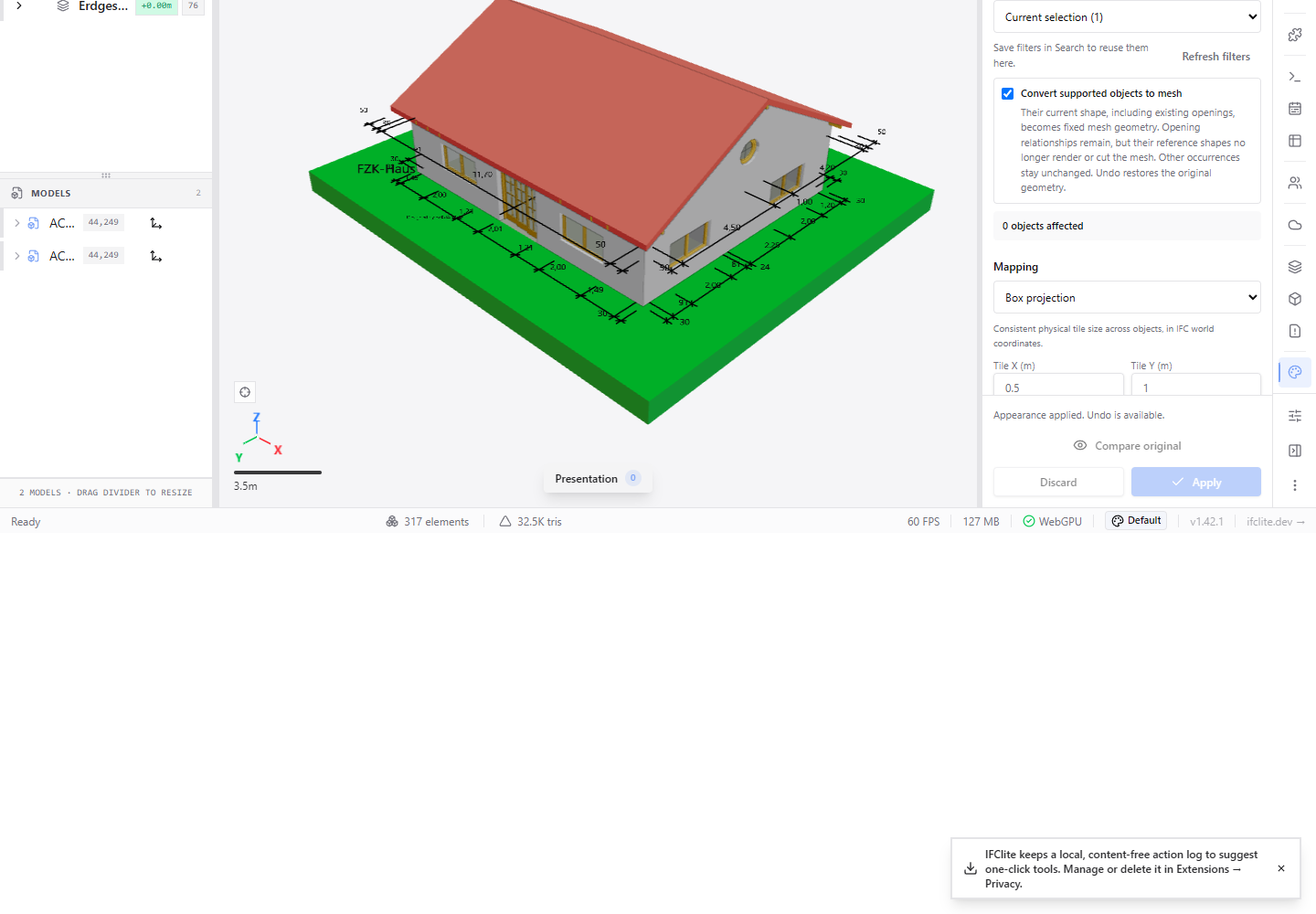
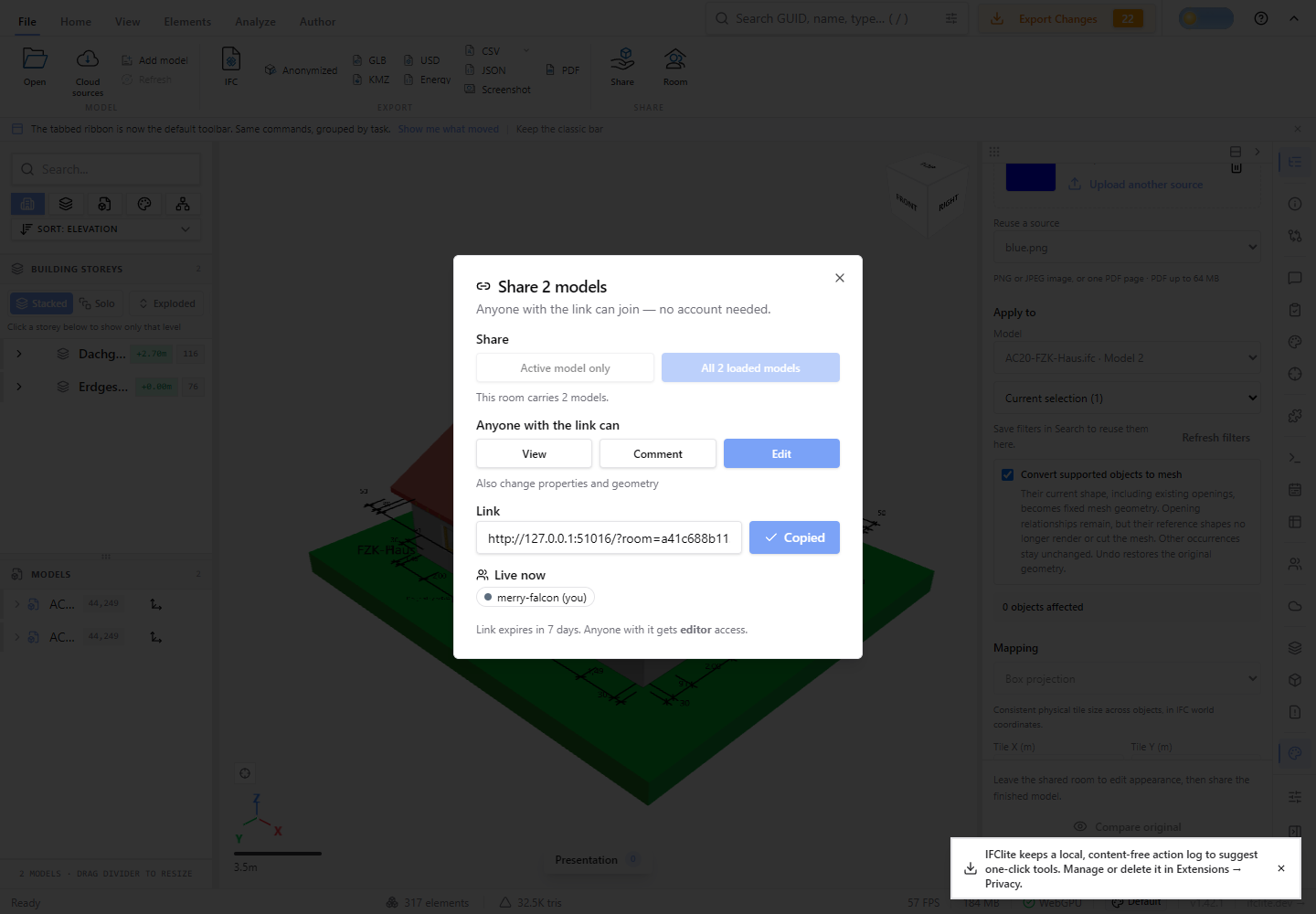
Owner profile (owner-two-copies-painted.png,
owner-share-all.png): Open AC20-FZK-Haus.ifc, Add Model
the same file, so the workspace holds two copies (317 meshes each, copy 2 at
federation offset 1 079 108). In the Appearance workspace the same mapped
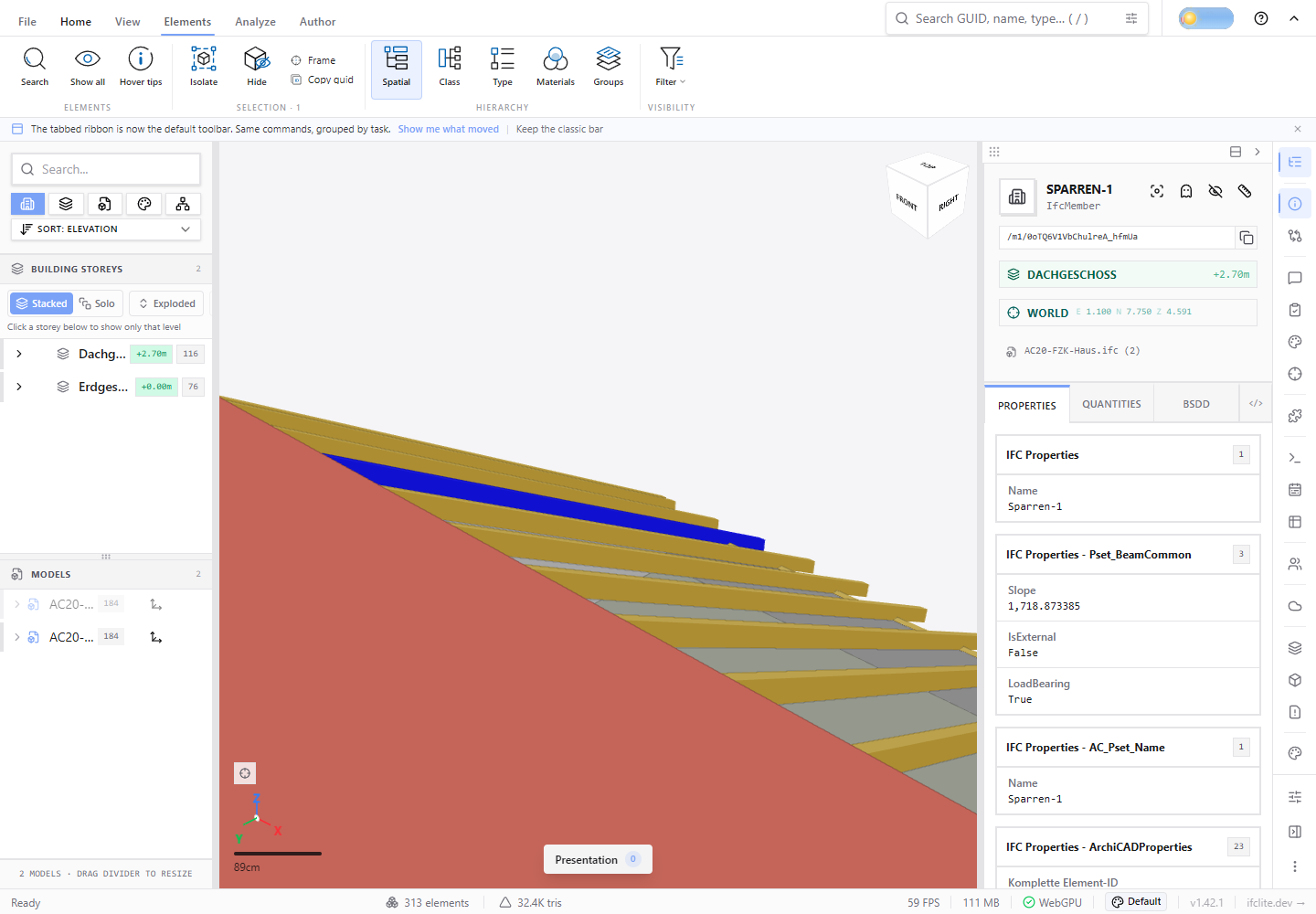
member — IfcMember 0oTQ6V1VbChulreA_hfmUa (Sparren-1, local #35169 in both
copies), the member of the #4420 evidence — receives an 8×8 solid red PNG in
copy 1 and a solid blue one in copy 2 (scope: current selection, "Convert
supported objects to mesh", box projection, tile X 0.5 m; both applies report
"Appearance applied"), giving the two copies two different texture sources
(textures/57cda6….png vs textures/5c1940….png). File → Share: the dialog
asks for the scope, All 2 loaded models is preselected and kept, Create
link creates the room; the link field shows the upload until every slot is
seeded and then the invite; the caption reads "This room carries 2 models.";
Copy puts the invite on the clipboard (read back and equal to the field).
The room's document at that point: slots m0, m1; 184 entities per slot;
313 geometry refs per slot; 626 geometry records; seed marker
seeded = expected = 634. The owner profile is then closed.
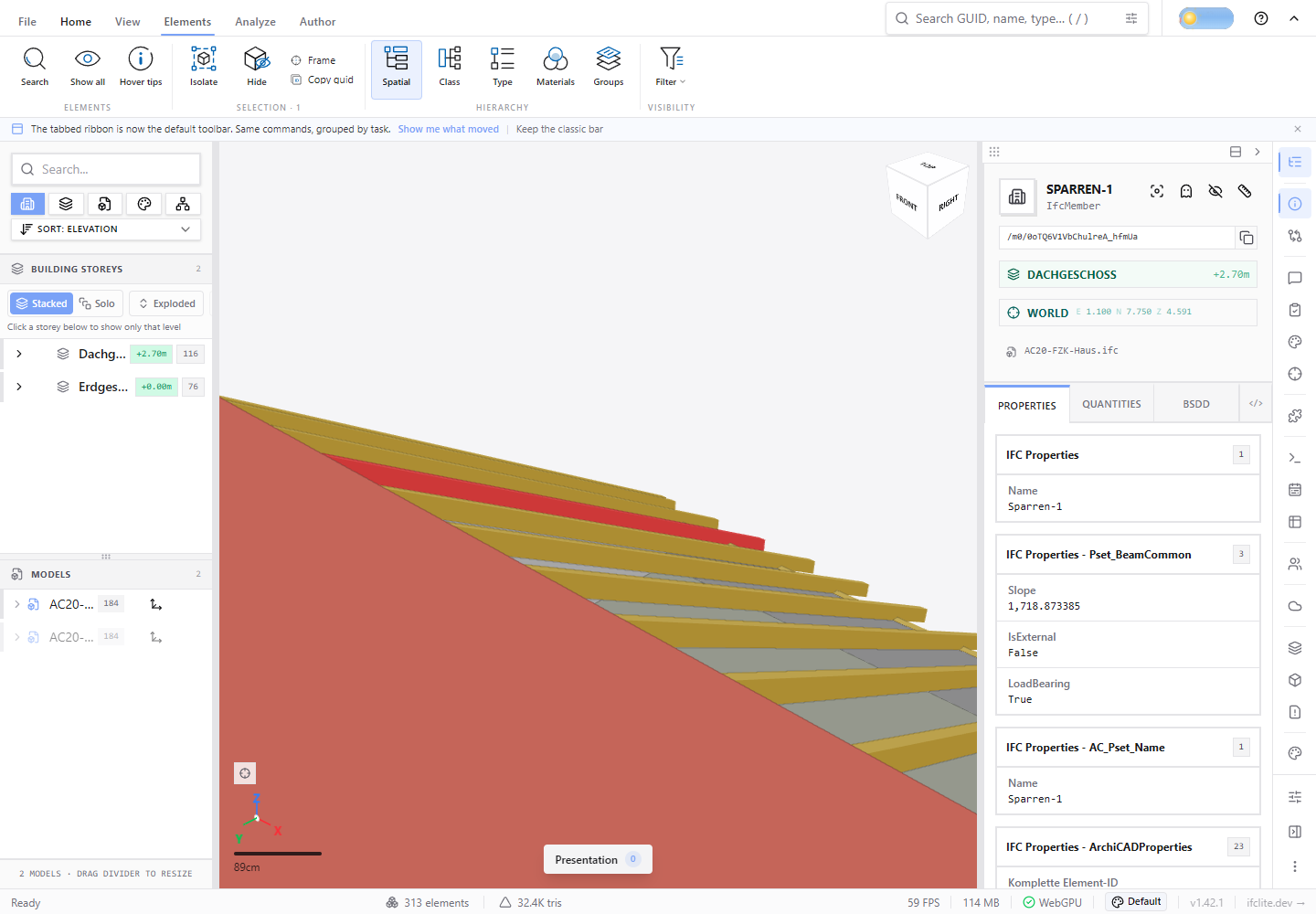
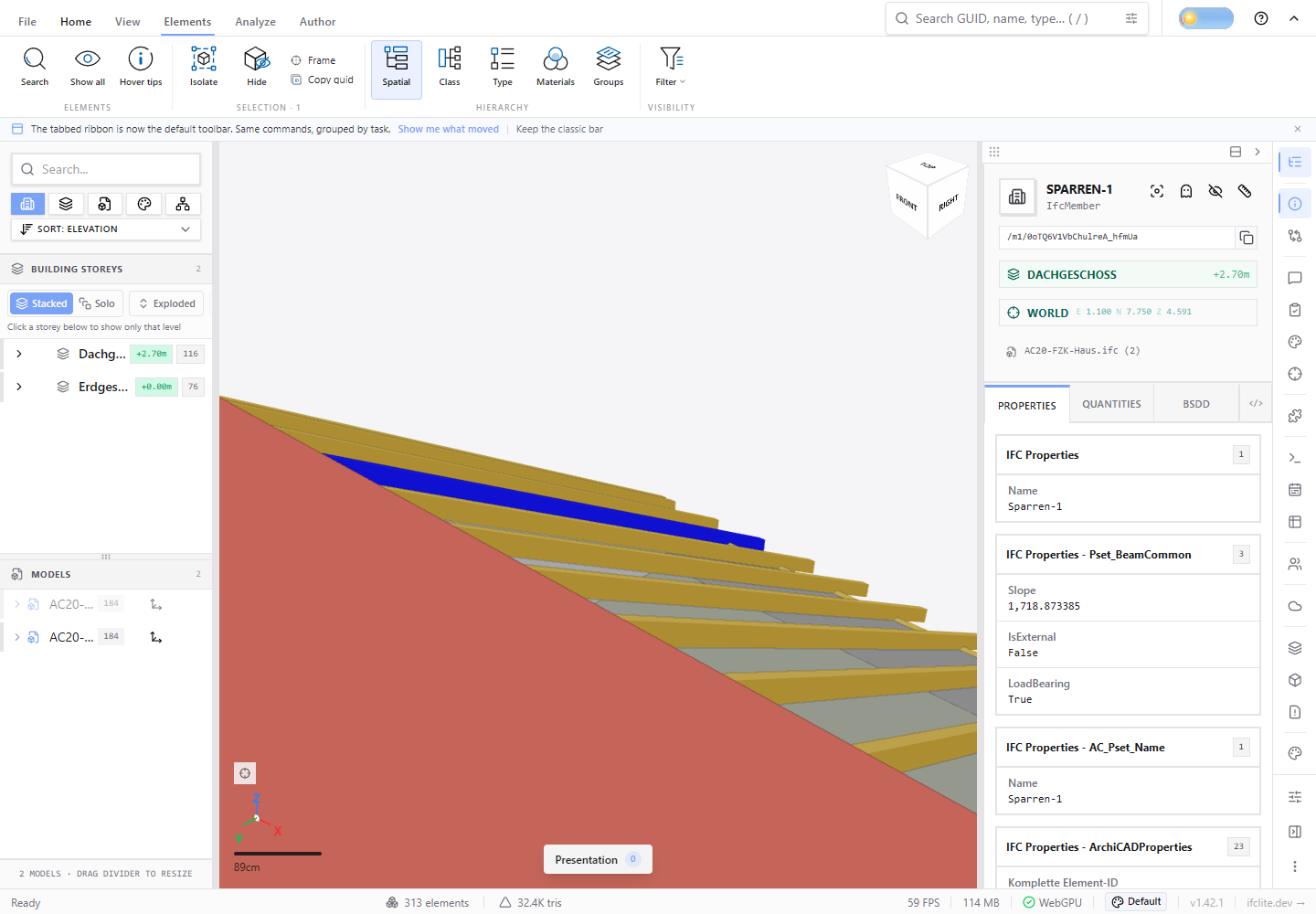
Fresh guest profile — opens the invite with nothing loaded (guest-copy-a-picked.png, guest-copy-b-picked.png):
| Check | Result |
|---|---|
| Room models | room:<roomId>:m0 "AC20-FZK-Haus.ifc" (offset 0) and room:<roomId>:m1 "AC20-FZK-Haus.ifc (2)" (offset 1 000 185); collabRoomModels.size = models.size = 2 = seeded slots; both listed in the hierarchy's Models section |
| Geometry | 313 meshes per model = the owner's refs per slot; the guest's copy of the doc has 184 + 184 entities, 626 records |
| Textures | the member's mesh in m0 decodes to [255, 0, 0] at its own UV, in m1 to [0, 0, 255]; two different texture blob hashes (e599dd…, 96db23…) |
| Store keys | /m0/0oTQ6V1VbChulreA_hfmUa in copy 1, /m1/0oTQ6V1VbChulreA_hfmUa in copy 2 |
| Picking | with the other copy hidden, the member framed and the roof slab that hides it (Elements → Hide selection, one occluder per copy) out of the way, a real canvas click at the member's projected triangle centre selects global id 47 → { modelId: room:…:m0, expressId: 47 } in copy 1 and 1 000 232 → { modelId: room:…:m1, expressId: 47 } in copy 2 (13 clicks each) |
| Geometry notice | collabGeometryNotice null; no "shared model … geometry" toast |
| Export | Export dialog, Model "AC20-FZK-Haus.ifc (IFC5)" then "AC20-FZK-Haus.ifc (2) (IFC5)", schema IFC5 (current), output .ifcx, Export: two downloads, AC20-FZK-Haus_export.ifcx and AC20-FZK-Haus -2_export.ifcx (the "(2)" copy suffix survives the extension strip, sanitizeFilename then rewrites the parentheses — the first run of this spec downloaded both copies under one name), 111 nodes / 108 entity paths each; the member at /0oTQ6V1VbChulreA_hfmUa with its ifclite::appearance::v1 fragment in both; no node path or child reference under /m0/ or /m1/ (sample) |
Rejoin — a third profile opens the same invite (rejoin-copy-b-picked.png): the same two models, textures, store keys and picks.
Control: "Active model only" (browser-run-active-only.json):
the same two loaded copies shared with the other scope produce one slot (m0),
one guest model "AC20-FZK-Haus.ifc" at offset 0 with 313 meshes, and the
member's global id equals its local express id (47) — the single-model
fallback globalId === expressId holds.
The full record of both runs is browser-run.json and browser-run-active-only.json (invite tokens redacted; the relay they were minted for no longer exists).
Defect found and fixed by this run
The first browser run lost the second copy's geometry: the guest got m1 with
0 meshes and no notice, while the owner's own doc held 626 records. The relay's
/metrics showed collab_rejects_total{reason="rate-limit"} 21 out of 245
update frames. seedGeometryToRoom resolved every mesh's entity path through
a callback that stamps that entity's placement baseline into the doc, each
stamp its own Yjs transaction — one websocket frame per entity, ~245 for two
copies in one burst against the relay's default per-connection budget of 200
(+60/s). The relay dropped the tail, and because Yjs integrates a client's
structs in clock order, every later frame from the owner (the rest of the
stamps, m1's geometry records and refs, the seed marker) stayed pending on
the server. One model (~120 stamps) never reached the budget, which is why no
single-model run saw it. The resolve is now one transaction per slot
(geometry-sync.ts); a two-copy seed is 9 frames (4 per slot + the marker),
pinned by owner-seed.frames.test.ts (synthetic 260-element copies, 527
frames before the fix) and by the AC20 test below.
Headless run (2026-09-12)
apps/viewer/src/lib/collab/room-two-copies.ac20.test.ts:
pnpm fixtures
cd apps/viewer && node node_modules/tsx/dist/cli.mjs --import ./src/test/vite-module-hooks.mjs \
  --test src/lib/collab/room-two-copies.ac20.test.ts
The fixture is parsed
twice by the real STEP parser (ColumnarParser.parseLite) and tessellated by
the real WASM geometry pipeline (GeometryProcessor.process), so both copies
share every GlobalId, every express id, the file name and the bytes. Copy B is
re-homed to federation offset 1 000 000 exactly as the loader does for an added
file; the first IfcWallStandardCase with a mesh gets a red 2×2 texture in copy
A and a blue one in copy B (the "different appearance source per copy" of the
issue's reproduction).
The run drives the real owner seed (runOwnerSeed), a real collab document, a
real MemoryBlobStore, the real recipient reconstruct
(createRoomReconstructor) with the real IFCX ingest, and the real model/data
store slices. Numbers reported by the test's diagnostic line:
| Quantity | Value |
|---|---|
| Entities seeded per slot | 184 |
Entities in the room (entities map) |
368 (= 2 × 184; nothing merged) |
| Meshes offered per copy | 317 |
| Geometry refs per slot | 313 (one entity carries byte-identical items; addGeometryRef keeps one ref per hash per entity, as in a single-model room) |
| Content-addressed geometry records | 626 (STEP blobs encode the global express id, so the two copies never dedupe onto each other) |
Blobs uploaded (seed marker seeded = expected) |
634 |
| Doc update frames for the whole two-copy seed | 9 |
Assertions that passed, for the fresh guest and again after leave → rejoin:
- the guest holds exactly
room:ac20:m0androom:ac20:m1, namedAC20-FZK-Haus.ifcandAC20-FZK-Haus.ifc (2)(the slot records keep the owner's name verbatim), in disjoint global-id ranges; - each model hydrated all 313 of its slot's refs, and the painted wall carries red pixels in copy A and blue in copy B;
- the painted wall's global id resolves (
resolveGlobalIdFromModels) to its own model and local express id in each copy — a pick lands on the right copy; - both models carry their own
ifcDataStoreandschemaVersion, which is what the Export dialog enumerates; the Export dialog's IFC5 branch (new Ifc5Exporter(store, geometryResult, undefined, idOffset).export({..., stripPathPrefix: roomExportPathPrefix(state, modelId) })) runs on each room model and emits 90 meshes per copy (the exporter's spatial-tree filter keeps contained elements only; the count is the same for both copies). The recipient's store keys the wall by/m0/<GlobalId>//m1/<GlobalId>; the exported file carries it at/<GlobalId>in both copies, every exported entity path is a GlobalId of the source model, no path or child reference carries a slot, the two files' entity nodes are identical and they differ only in the texture carriers (red vs blue pixels), with the wall's texture written as anifclite::appearance::v1fragment in both; - leaving drops both room models; rejoining rebuilds both.
What the headless run does not claim
The headless run is a Node run: runOwnerSeed → MemoryBlobStore →
createRoomReconstructor, no websocket, no relay budget — which is exactly why
it could not see the frame-budget defect the browser run found. Merged
(federated) export is STEP-only in the dialog, so a recipient exports each room
model to its own .ifcx. Path-valued attributes of a custom IFCX schema are not
re-homed under a slot by either run (documented limit, see
docs/contributing/collaboration-testing.md).