Evaluated occurrence viewer acceptance (#4404)
The real Archicad IFC4 AC20-FZK-Haus.ifc fixture exercises the shipped GPU
instancing path. The selected IfcMember #35169 initially has no resident flat
mesh. Its source leaf #35135 is shared with other mapped occurrences. Fixture
SHA-256: ea6f04eaf92fac4d7ad0038bc3d2dfea4c094dd3f516ecc33c50bf1835ca108d.
The manual browser harnesses under tools/texture-authoring/ use a fresh Chromium
WebGPU session and the canonical file input. They exercise the actual Appearance
panel, native worker, renderer, mutation history and IFC export dialog:
- Upload the public CC0 boulder diffuse image and opt into mapped-object conversion.
- Preview the selected member, compare its original shared instance, and return to the textured preview.
- Apply once. The member has one textured flat piece; its dormant original is excluded from the live instance inventory. The untouched sibling is unchanged.
- Undo restores the original mapped representation and GPU instance, removing the materialized model mesh. Redo restores the textured occurrence.
- Apply a second tile size, hide and show the owning model, then Undo twice to restore its original mapped instance and Redo twice to restore one textured occurrence. The real Author toolbar is used in both single and federated runs.
- Export IFC + images through the normal export dialog. The packaged PNG is
byte-identical to the uploaded 546,426-byte source, SHA-256
f2be22cb22f33a21bd40eab8b3da5c2df4f537841687f58af746413a9c172203. - Reopen the IFCZIP in a fresh browser and click the member in the actual viewport. Selection resolves its original GlobalId and IFC properties.
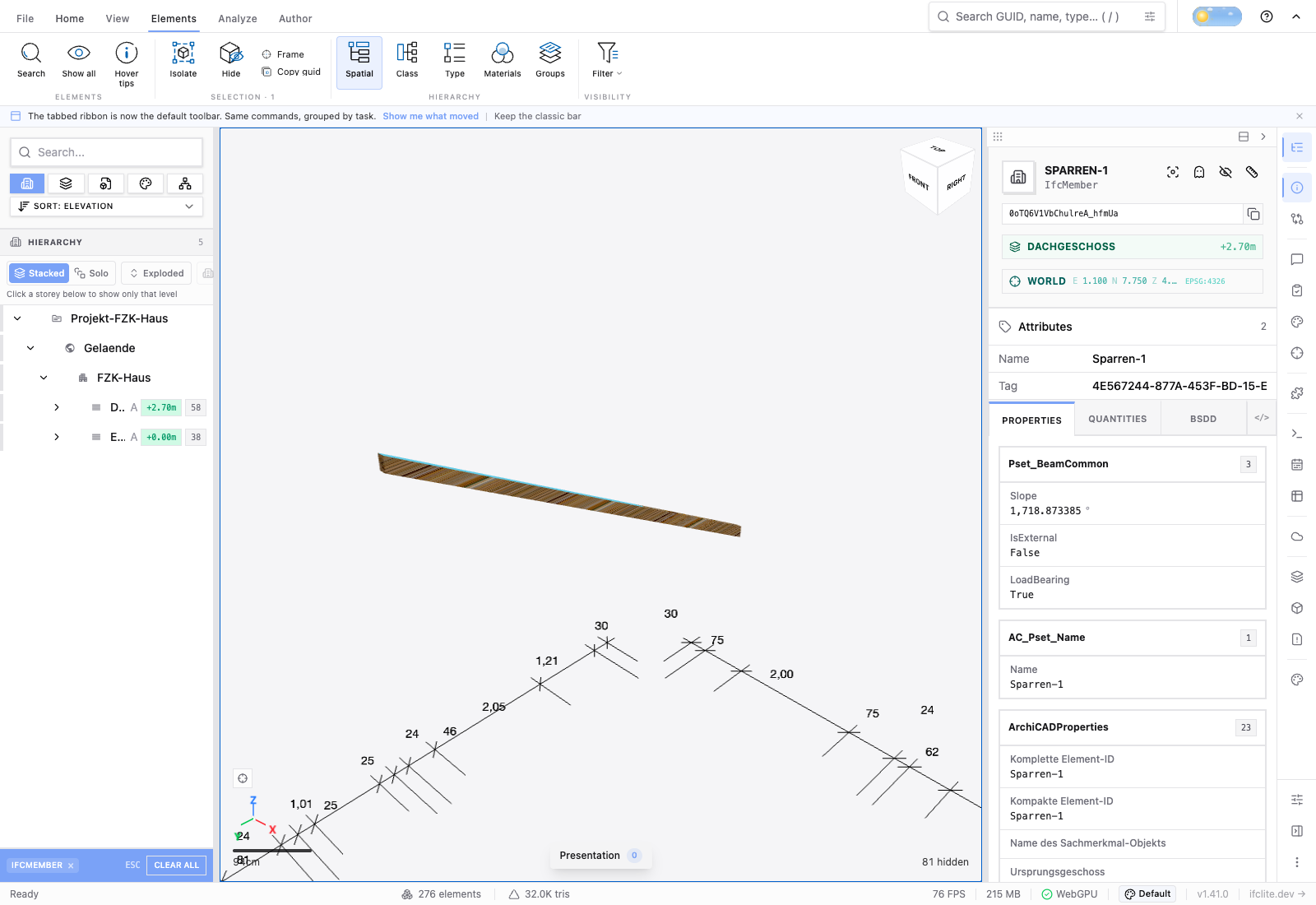
Single-model observations and federated observations record the model and Scene inventory before, after, and across Undo/Redo. They are behavioral observations, not a load performance benchmark. The texture uses planar projection in this run; stretching on faces parallel to the projection direction is not evidence of an existing-UV transfer. Existing UV mapping remains refused for this conversion policy.
An independent IfcOpenShell 0.8.2 reader reopened the actual browser-exported STEP file. The result verifies 12 triangles, the same GlobalId, and only the occurrence's existing Body wrapper #35155 changed among original entities. Its maximum source-corner distance is below a micrometre. The fixture already has 170 schema findings; export retains those 170 with no new findings. This does not claim that the source model is schema-clean.
Automated coverage uses eight mounted actual-WASM cases: image and finite PDF page, resident and GPU-instanced occurrence, single model and federation. Instanced cases mount the real geometry-streaming hook. They verify the portable image/atlas binding, original/replacement item provenance, sibling isolation, Apply/Undo/Redo, and hidden-source history retention. The federated cases also exercise a nonzero registered model translation while keeping publication in model-local coordinates. The PDF fixture supplies a controlled raster derivative; actual PDF decoder fidelity is covered by the separate PDF acceptance work.
Choosing an Appearance target model activates its existing model-scoped toolbar history. In federation, export explicitly selects that model in the export dialog. This acceptance covers mapped occurrences without openings; post-opening conversion and stable face-mask work remain tracked by #4404.