Face-mask workspace acceptance (#4404, PR-2)
The viewer's face-selection UI, split-part preview and history for masked
evaluated occurrences, verified on the real Archicad IFC4 AC20-FZK-Haus.ifc
fixture (SHA-256 ea6f04eaf92fac4d7ad0038bc3d2dfea4c094dd3f516ecc33c50bf1835ca108d)
in a real browser, and reopened by an independent reader. The contract is in
the representation policy
("Face masks"); the native plan and its reopening are in
../../evaluated-face-masks/.
Browser journey (Playwright, real Chrome, WebGPU on a real GPU)
tests/e2e/appearance-face-mask.e2e.spec.ts, project viewer-appearance-e2e
(opt-in, not in CI's default lane), against the built viewer served by the
Playwright web server:
pnpm --filter @ifc-lite/viewer build
APPEARANCE_E2E=1 APPEARANCE_E2E_OUT=/tmp/face-mask-ui pnpm exec playwright test --project=viewer-appearance-e2e
The Playwright web server reuses an existing server on its port, so on a host
where another checkout may be serving port 3000, set PLAYWRIGHT_PORT=<free
port> so the run serves and tests this build.
The recorded run on this host (Windows 11, NVIDIA GPU, Chrome stable,
headless, the branch's final build after review, served on PLAYWRIGHT_PORT=3471)
took 14.2 s including the model load and passed every assertion; earlier
iterations of the same spec passed as well, with journey JSON identical apart
from the random model id. The journey on
IfcMember #35169 (one of 42 members sharing a type; sibling #35304 compared
corner-for-corner at every step), recorded in
browser-journey.json:
- Load, select the member, open Author → Appearance, upload a 64 px checker
PNG generated by the spec, opt into Convert supported objects to mesh.
The whole-surface preview stages one textured part (12 triangles); the
panel lists the member with the chip
all 12 faces. - Select faces opens the editor on the member's evaluated surface; Pick
faces, a marquee over the left half of the canvas selects 6 of the 12
source triangles (
6 of 12 faces selected). The preview re-plans with the mask and stages two parts of the one owner: item 79109, 6 triangles, textured, and item 79111, 6 triangles, untextured with the source colour[0.714, 0.557, 0.333, 1]. The union of their placed corners equals the loaded member's 36 corners exactly. In the screenshot the member carries the viewport's selection highlight (the scope is the selection), so the texture shows only in the applied screenshot below.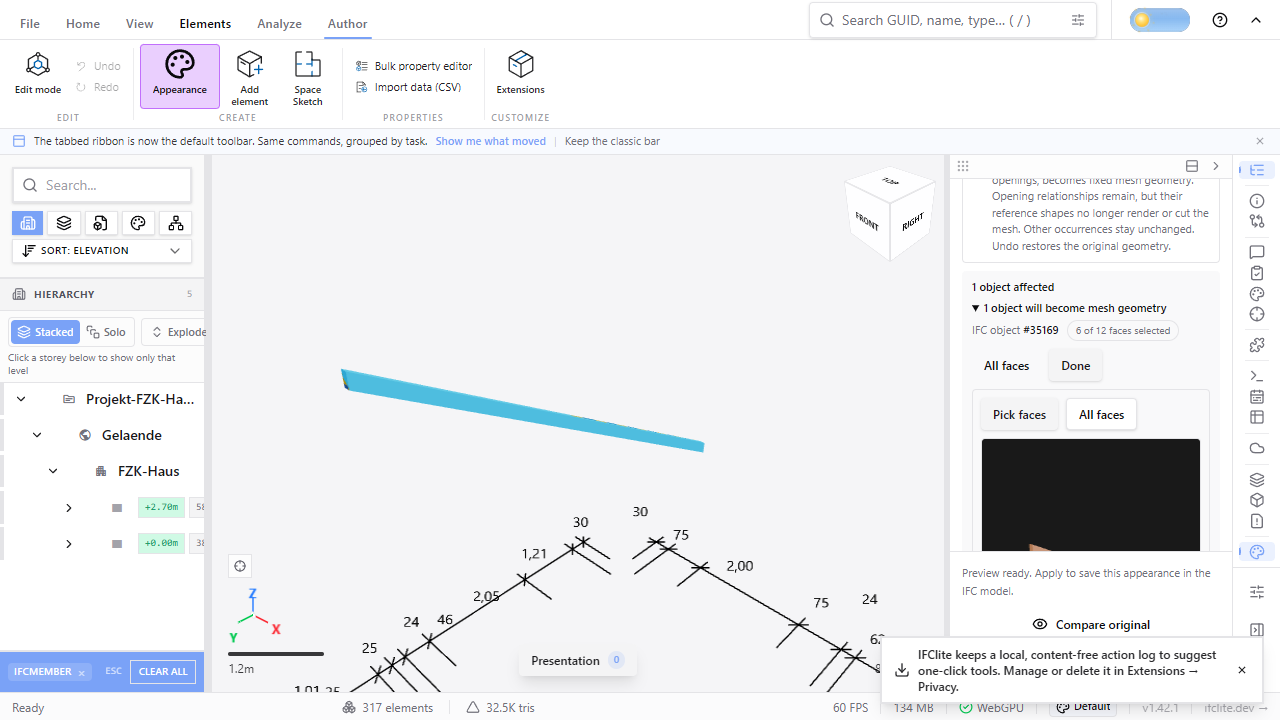
- Discard restores the loaded member exactly (one part, item 35135); the selection survives, and changing the tile width previews the split again.
- Apply: one history step, 14 mutations (12
CREATE_ENTITY, the rest on the occurrence Body wrapper #35155 — the only existing entity edited), two meshes for the member in the model geometry, selection unchanged.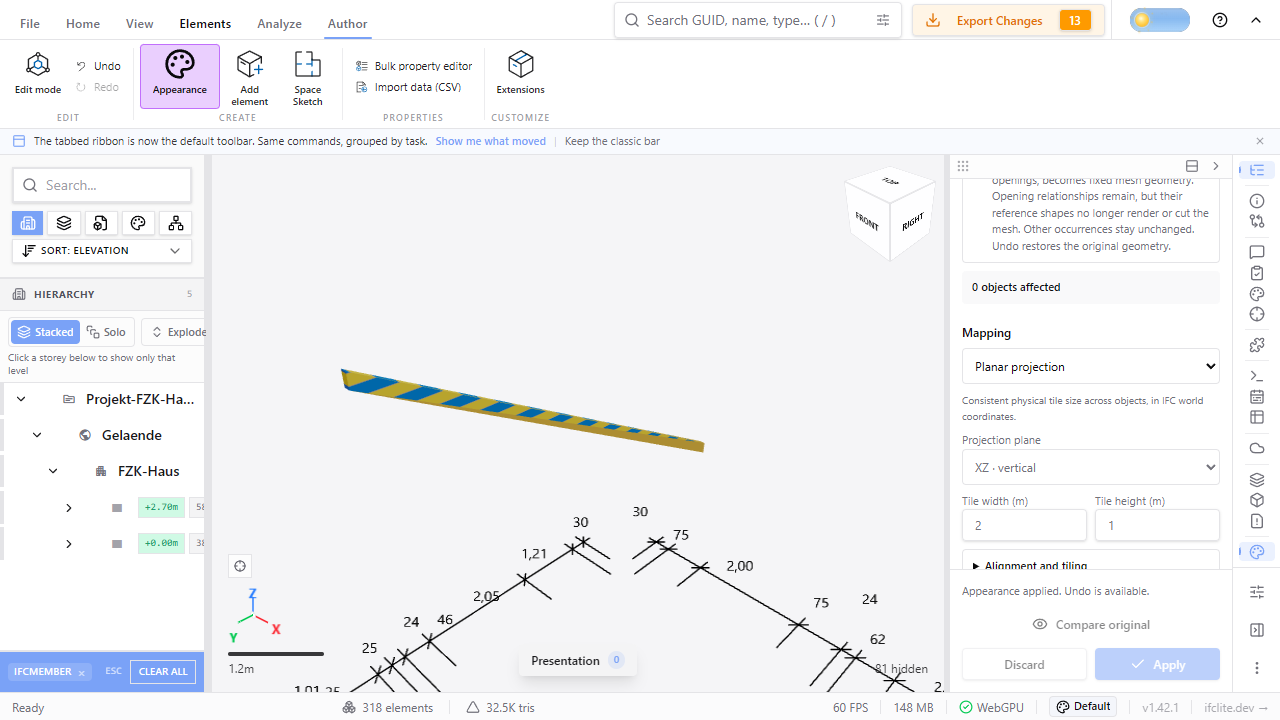
- Undo restores the loaded member exactly; Redo restores both parts.
- Clearing the selection and clicking the member in the viewport selects product #35169 again.
- Export IFC (with changes) through the export dialog produces
AC20-FZK-Haus_export.ifczip(510 KB) with the checker PNG. - A fresh page reopens the IFCZIP: the member renders as its textured and
retained face sets (6 + 6 triangles, same corners as the original load),
sibling #35304 is identical to its original load, and a viewport click
selects the member, whose properties show GlobalId
0oTQ6V1VbChulreA_hfmUa.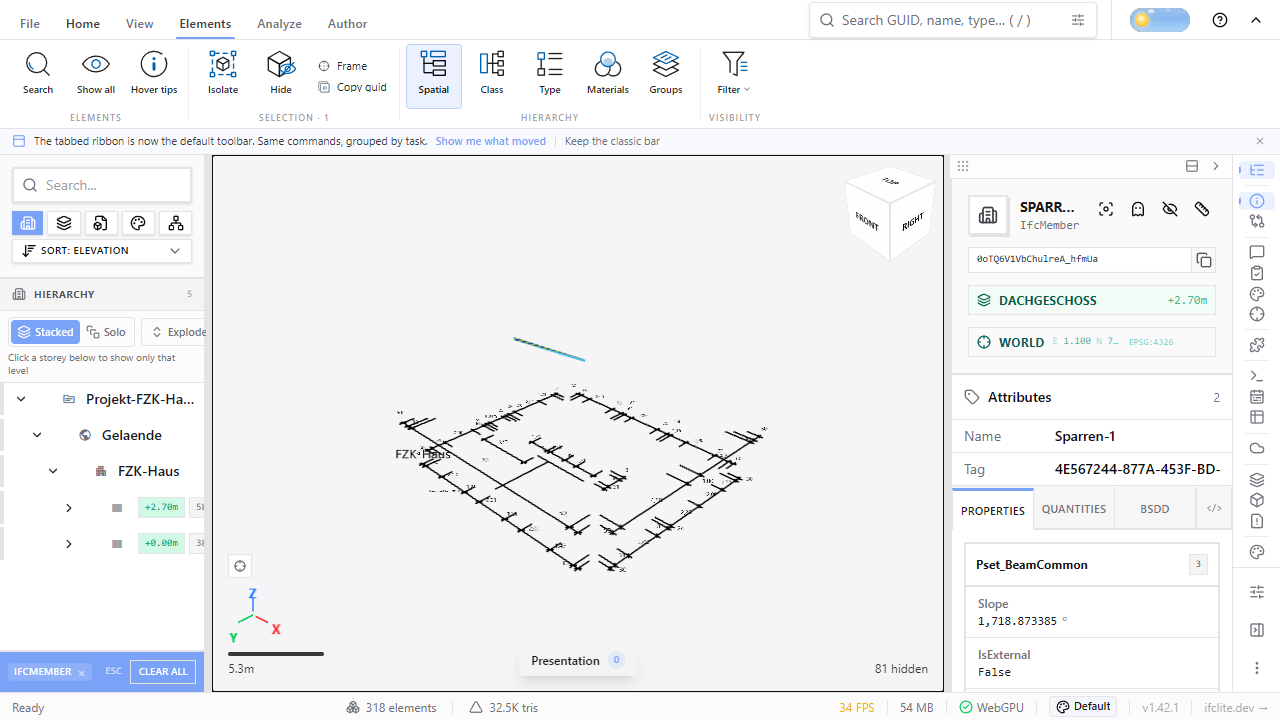
No page error was raised in either page. In the browser build both members
load as resident flat geometry, so this run exercises the resident preview
path. The GPU-instanced path is
covered by the mounted node test below (appearanceInstanceScene), not by a
browser screenshot.
Independent reopening (IfcOpenShell 0.8.3.post2)
verify-mask-export.py reads an exported .ifc or
.ifczip and needs no native plan, so it applies to the browser export:
python docs/architecture/evidence/evaluated-occurrences/face-mask-ui/verify-mask-export.py \
  tests/models/ara3d/AC20-FZK-Haus.ifc /tmp/face-mask-ui/AC20-FZK-Haus_export.ifczip 35169 browser-export-reader.json 35155
browser-export-reader.json: among existing
entities only #35155 changed; the Body is one Tessellation wrapper with the
textured face set 79109 (6 triangles, IfcSurfaceStyleWithTextures, one
IfcIndexedTriangleTextureMap, image present in the archive) and the retained
face set 79111 (6 triangles, original style entity #17391, no texture map),
both over one point list; the authored corners lie on IfcOpenShell's own
tessellation of the original member within 1.0e-7 m in both directions with
equal area (3.07797 m², difference 4e-7); the reader tessellates the export into
the same 12 triangles; all 41 sibling members have identical world tessellation
digests before and after; 170 schema findings before and after, none new.
Masked opening-bearing product. The browser journey covers the member, so
the cut slab #59290 (one opening, cloned type-shared wrapper) was exported
through the viewer's own apply path with a 16-of-32 mask by
tools/texture-authoring/export-face-mask.mjs and reopened the same way:
TSX_TSCONFIG_PATH=apps/viewer/tsconfig.json node --import tsx --import ./apps/viewer/src/test/vite-module-hooks.mjs \
  tools/texture-authoring/export-face-mask.mjs tests/models/ara3d/AC20-FZK-Haus.ifc 59290 first-half /tmp/face-mask-slab
python docs/architecture/evidence/evaluated-occurrences/face-mask-ui/verify-mask-export.py \
  tests/models/ara3d/AC20-FZK-Haus.ifc /tmp/face-mask-slab/AC20-FZK-Haus-mask-59290.ifczip 59290 slab-export-reader.json 59286,59354
slab-mask-plan.json records the request and the
conversion (masked ordinals 0–15 of 32, the opening companion #59365 removed
from rendering, edits on #59286 and #59354). slab-export-reader.json:
only #59286 and #59354 changed among existing entities (the
ProductDefinitionShape rewire and the opening's representation becoming
Reference); textured and retained face sets of 16 triangles each over one
point list, the retained one keeping source style #34488; the authored 32
triangles lie on IfcOpenShell's tessellation of the original cut slab within
1.1e-5 m in both directions and reproduce its area (211.4991 m² versus
211.4995 m², 2e-6 relative); the three other slabs are unchanged; 170 findings
before, 169 after, none new. IfcOpenShell's own re-tessellation of the
exported face sets yields 41 faces and 211.16 m²: OpenCASCADE sews the
48-point list (16 distinct positions) and re-triangulates the faces with holes,
so the reader's remesh — not the authored geometry, which is exact — is what
differs; the oracle therefore compares the authored face sets and reports the
remesh. The planar member reopens 1:1.
Node-level coverage (real wasm, node:test via tsx)
apps/viewer/src/components/viewer/appearance/AppearancePanel.faceMask.test.tsx: the mounted panel with the real planner on a controlled two-triangle mapped quad, resident and GPU-instanced — select one face through the editor's click gesture (the editor's renderer is not re-created by the click or its re-plan), preview the split, turn the evaluated policy off (the request carries no mask, the policy's own exclusion shows) and on again (the selection returns), Compare, Discard, preview again, Apply, export with the image, reopen, Undo, Redo; the sibling occurrence unchanged. Its #4557 mode rasterizes page 1 of the CC0 controlled PDF through PDF.js at a bounded 18 dpi, calibrates a measured source span, and sends the actual page pixels and one-of-two face mask through native page planning. The selected product is deliberately resident in two stream fragments. The test proves the complete fingerprint plusmaskedTriangles, finite-page clamp, textured and retained preview fragments, stale-fingerprint and excessive-memory refusal, IFCZIP derivative transport, and reopened product ownership with the selected-face UV/image association and retained original style.apps/viewer/src/lib/appearance/face-mask-reopen-wasm.test.ts: the AC20 member's masked export (6 of 12) reopened through the loader's parser and wasm geometry pipeline: two items under one product, textured binds the portable image, retained keeps the colour, corners partition exactly, 41 siblings byte-identical, one extra mesh.apps/viewer/src/lib/appearance/face-masks-wasm.test.ts: request scoping and reconciliation against the real planner; a geometry edit of a masked swept box (profile widened) is reported stale and the workspace drops the mask with its diagnostic; for a (12.345, 67.891, 0.1) m translation the test asserts the invariant only — kept on the identical fingerprint or dropped as stale, never misapplied — because the native and wasm planners currently disagree on that verdict (#4550; the wasm build keeps both fingerprints).apps/viewer/src/lib/appearance/preview-mask.test.ts,preview-history.test.ts,packages/renderer/src/appearance-partition.test.ts: the split binder, the partition's Undo/Redo inversion and the renderer's exact partition contract. The #4556 cases force a six-index streaming threshold over a four-triangle surface, select triangles on both fragments, preserve the complete canonical corner map and the retained fragments' prior UV/texture references, and exercise repeated source/generated item ids, empty halves, Apply, Discard, Undo, Redo, overlap, reorder, stale-provenance and work-budget refusal. The portable result is still the native two-face-set plan exercised byface-mask-reopen-wasm.test.tsand the independent-reader runs above; streaming fragmentation is a viewer residency detail and does not enter the exported IFC.
Not verified here
No timing or performance claim (no Rust or wasm change in this slice). The browser run used one GPU and one Chrome build. The face editor draws on its own WebGPU context and re-renders on demand, so the capture shows only part of its surface. The face-selection marquee depends on the editor's initial camera; the spec accepts any partial selection and falls back to a single click, so the 6-of-12 figure is this run's, not a fixed expectation.