Captured IFC appearance through sharing (#4380)
A normal Share workflow was exercised using an IFCZIP produced by the captured
region UI: two original walls plus one textured IfcBuildingElementProxy with
40,087 triangles. Every stage retained three meshes and 40,091 total triangles.
Measured results pin the input, original JPEG, tested source commit,
WASM runtime and room-export hashes.
The owner opened /tmp/capture-ui-browser/captured.ifczip through the ordinary
file input and clicked Share. A fresh browser context followed that signed local
room link. Both original contexts were then closed before a different fresh
context rejoined. That guest exported the room through the ordinary export dialog,
and another fresh context reopened the resulting IFCX. The relay was local, with
an ephemeral secret generated in process; no existing user room or token was used.
All browser contexts and both temporary servers were stopped after acceptance.
Appearance and geometry
All 120,261 oriented triangle corners of the captured owner were compared through world position and associated UV at each stage. Fresh join and fresh rejoin retain exactly identical positions/UVs. Reopening the exported IFCX folds the per-mesh origin into Float32 positions: maximum world component error is 2.9802322387695312e-8 m, maximum Euclidean corner error is 3.332000937312528e-8 m, and UV error is zero. Every component is within one Float32 round-to-nearest step at its local coordinate magnitude. Repeat S/T remain true. This is much tighter than the declared 1e-5 m world / 1e-6 UV comparison tolerances.
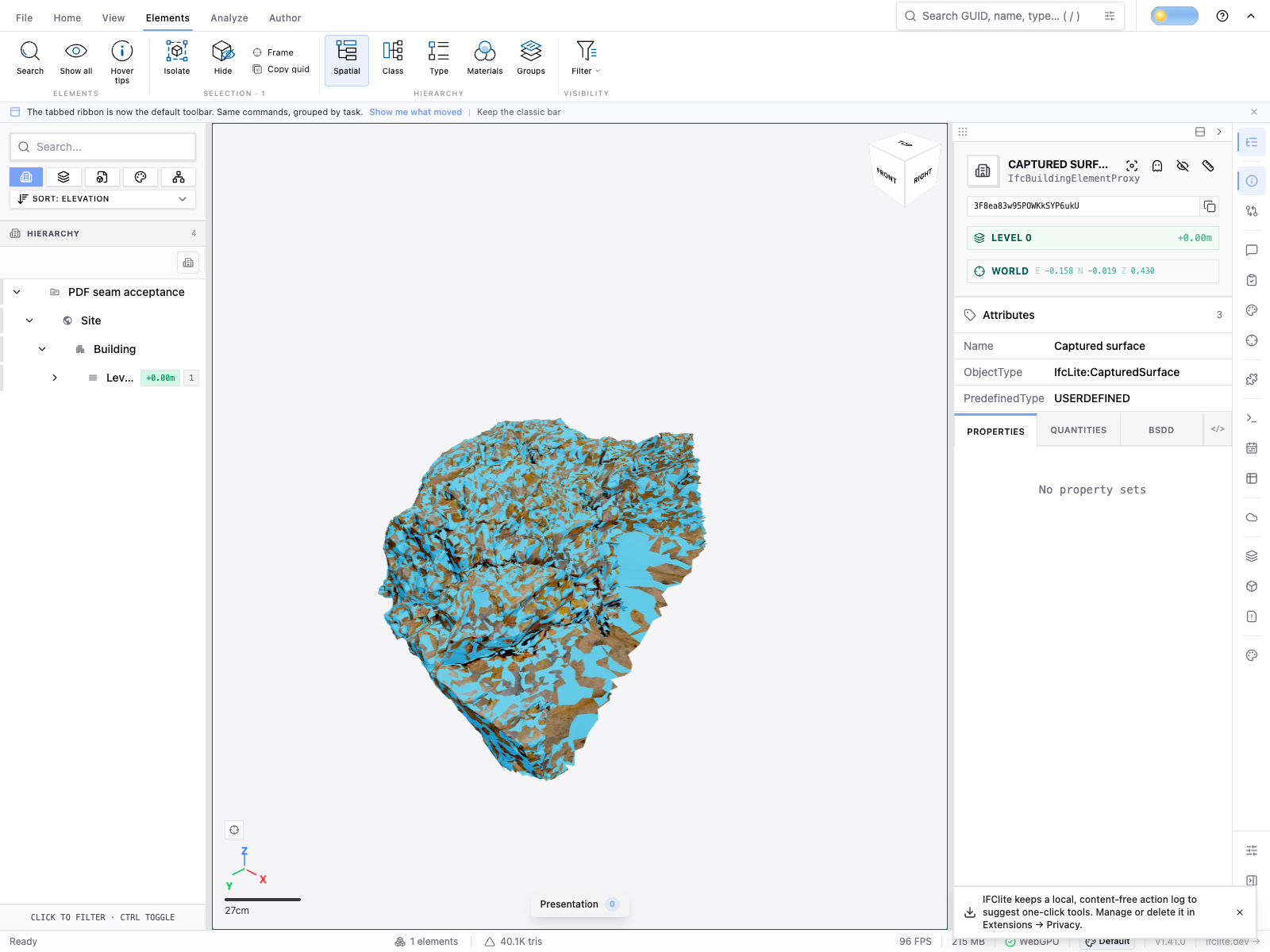
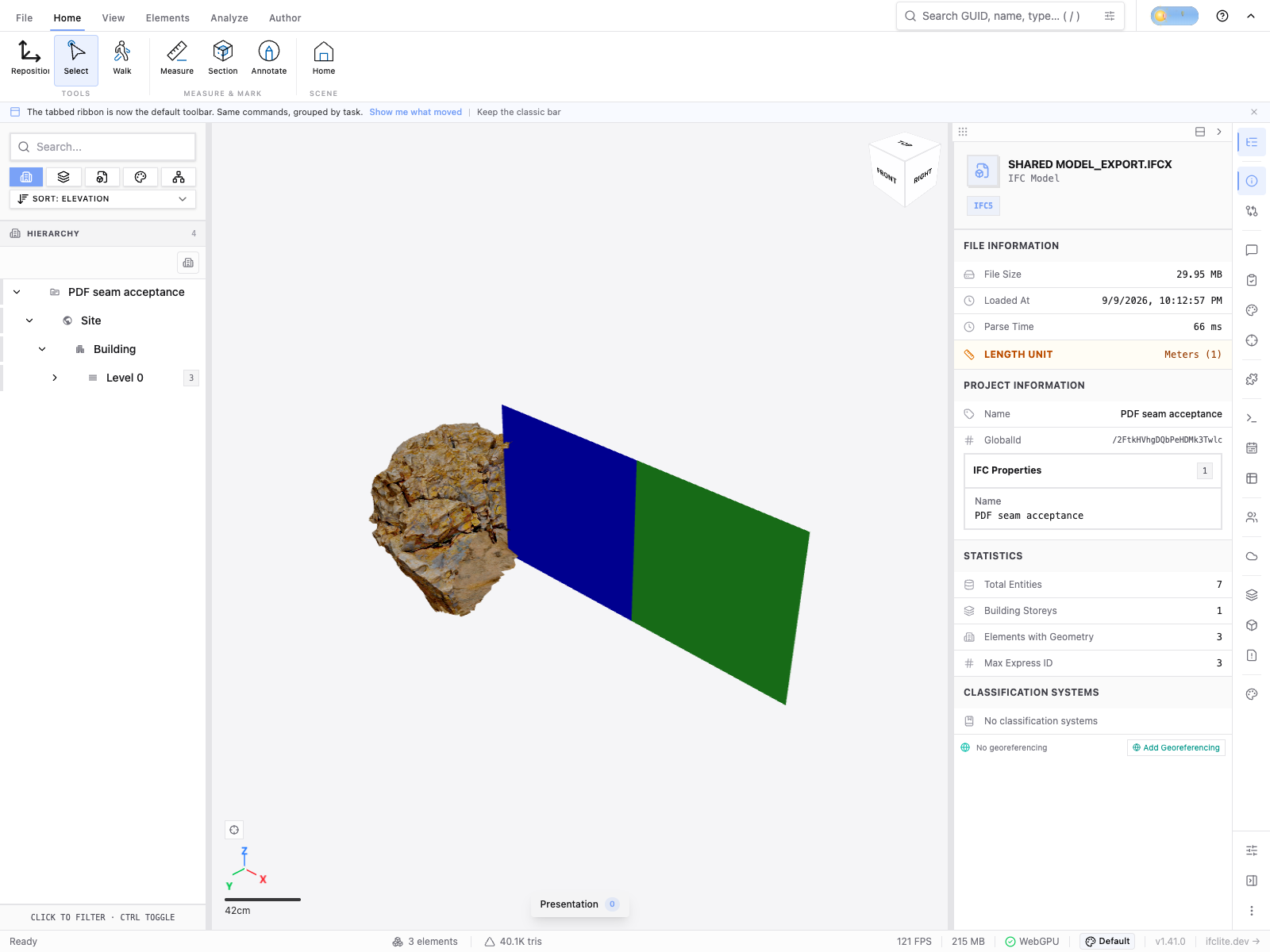
The first exploratory run rejected a rounded-grid signature despite these tiny errors: values can cross a quantization boundary while remaining far closer than one grid cell. That hash mismatch was not treated as a geometry defect. The accepted run compares actual indexed corner differences and checks the Float32 rounding bound. The unselected screenshot below is from that first exported-model reopening; the later complete run independently passed geometry, appearance and selection.
Each browser snapshot reports the same decoded 1024×1024 RGBA FNV hash. In addition,
an independent pixel comparison decodes the original JPEG with
Pillow and compares all 4,194,304 RGBA bytes directly against the room-export IFCX's
embedded image: they are byte-identical, with SHA-256
2c2dc5a76bc993bfc7bb86a4ddef95baecbc46161467fd45b7f8ccf1cc6077f1.
This proves decoded-pixel transport. It does not claim that room transport keeps
the original compressed JPEG bytes. The initial IFCZIP separately contains the
original 987,467-byte JPEG with its original digest.
Actual object selection
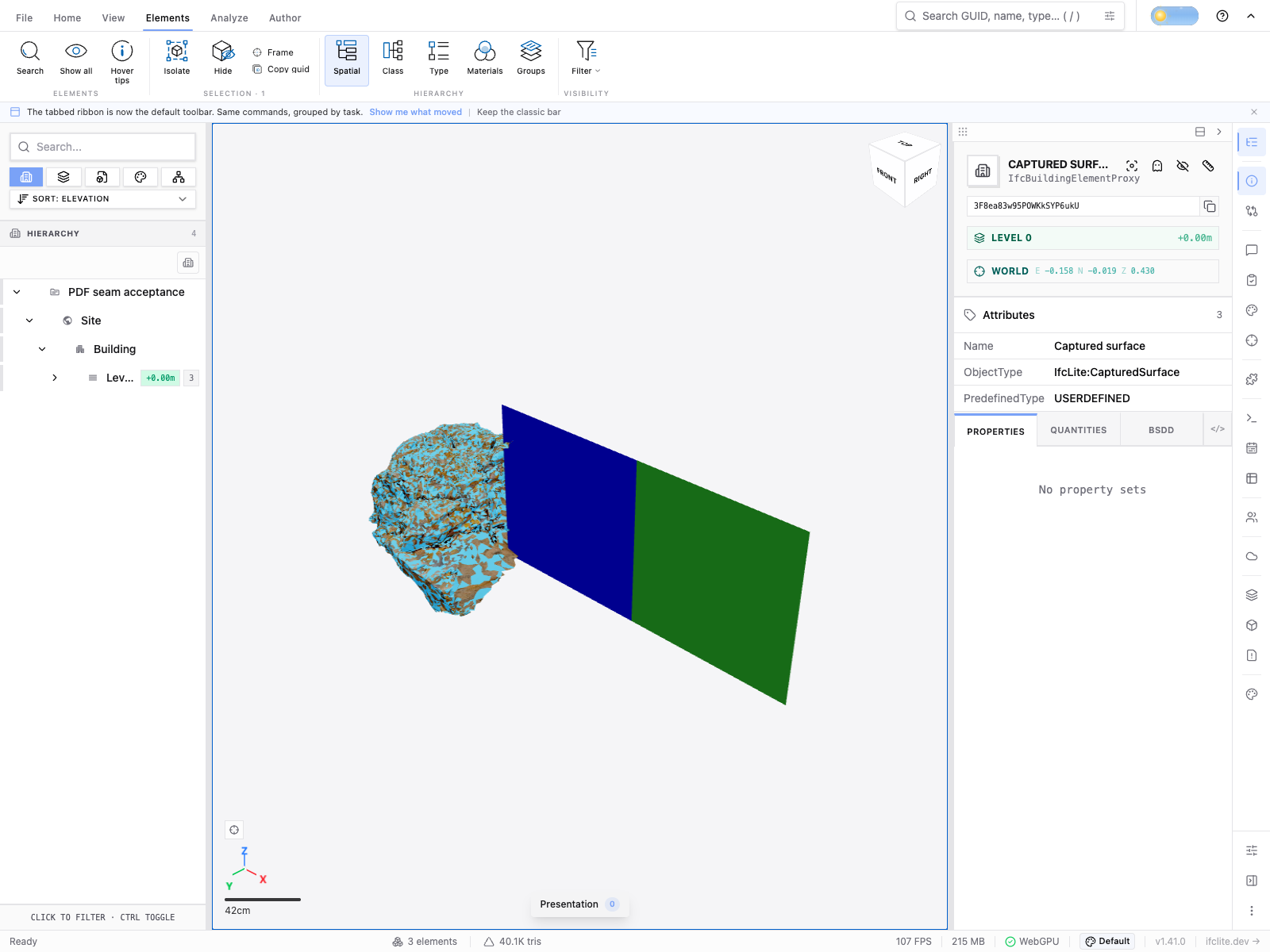
Mouse clicks went through normal viewer selection, targeting visible captured
faces rather than either wall. The selected owner was verified as
IfcBuildingElementProxy, with the 40,087 textured triangles, in all four contexts.
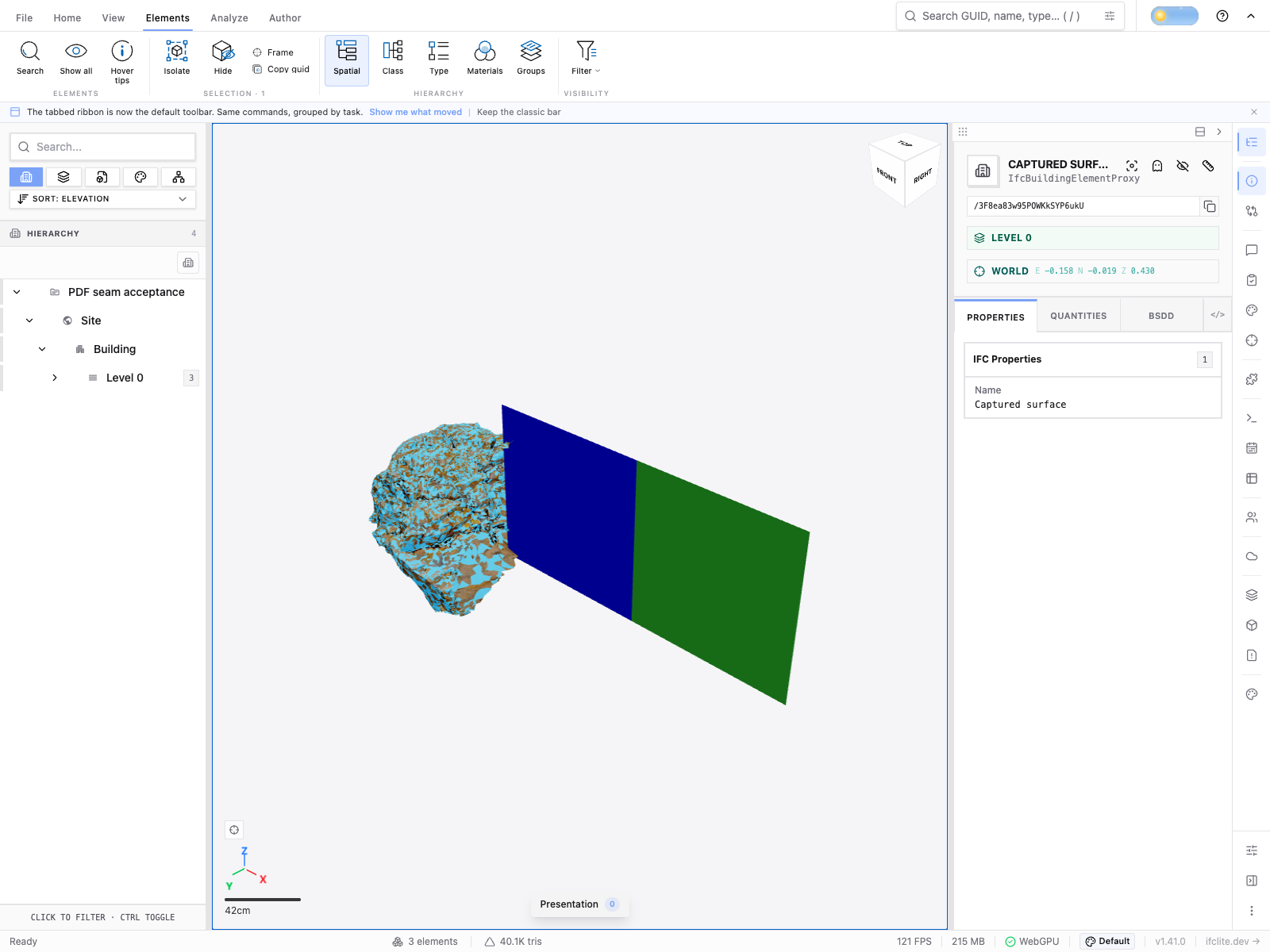
The ordinary IFC uses EXPRESS ID 65; room IFCX uses 4 and the reopened export uses 3.
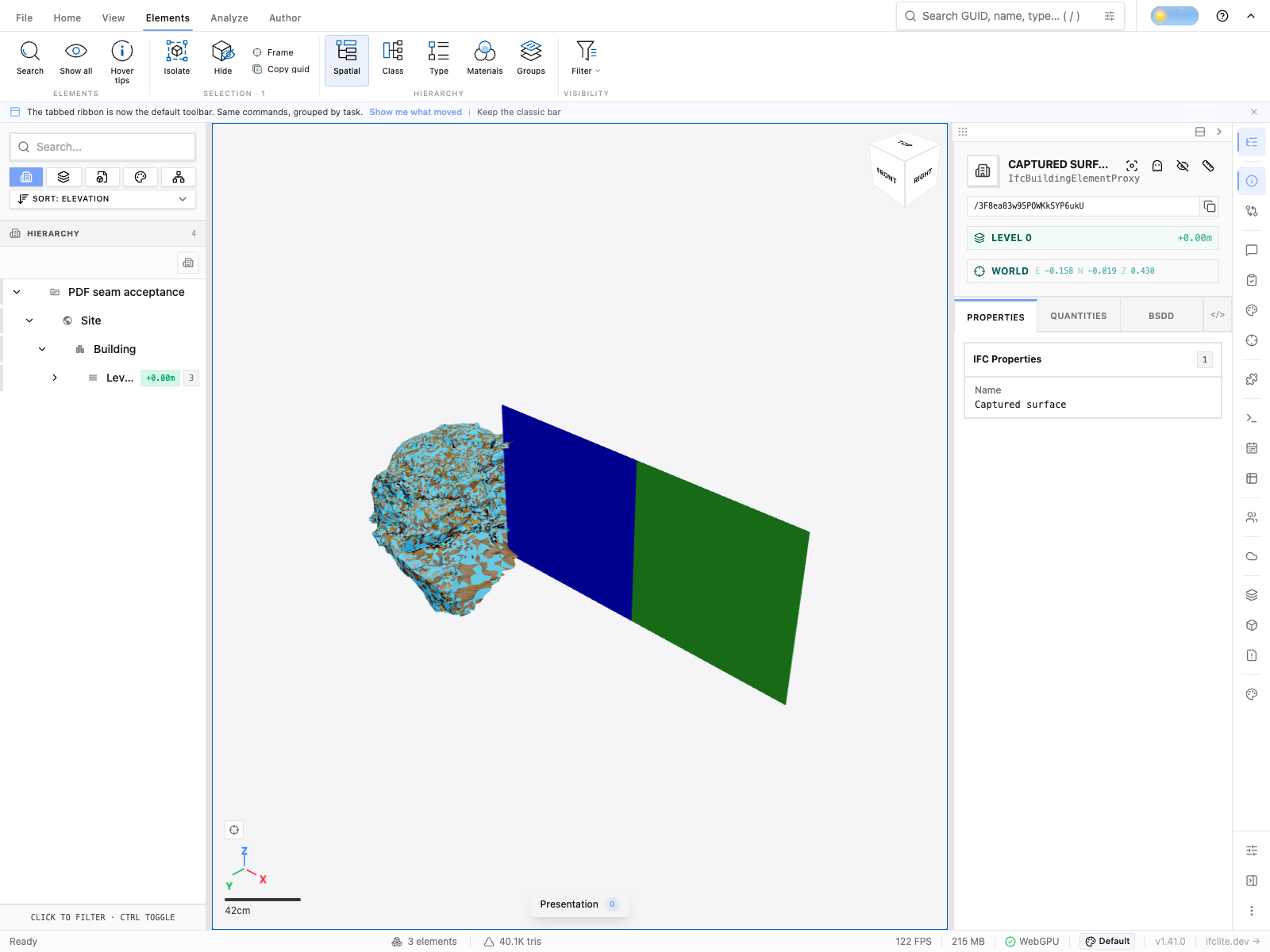
The original IFC GlobalId 3F8ea83w95POWKkSYP6ukU becomes IFCX path
/3F8ea83w95POWKkSYP6ukU. Those are documented identity mappings, not a claim of
unchanged numeric IDs or an unchanged IFC GlobalId string across formats.
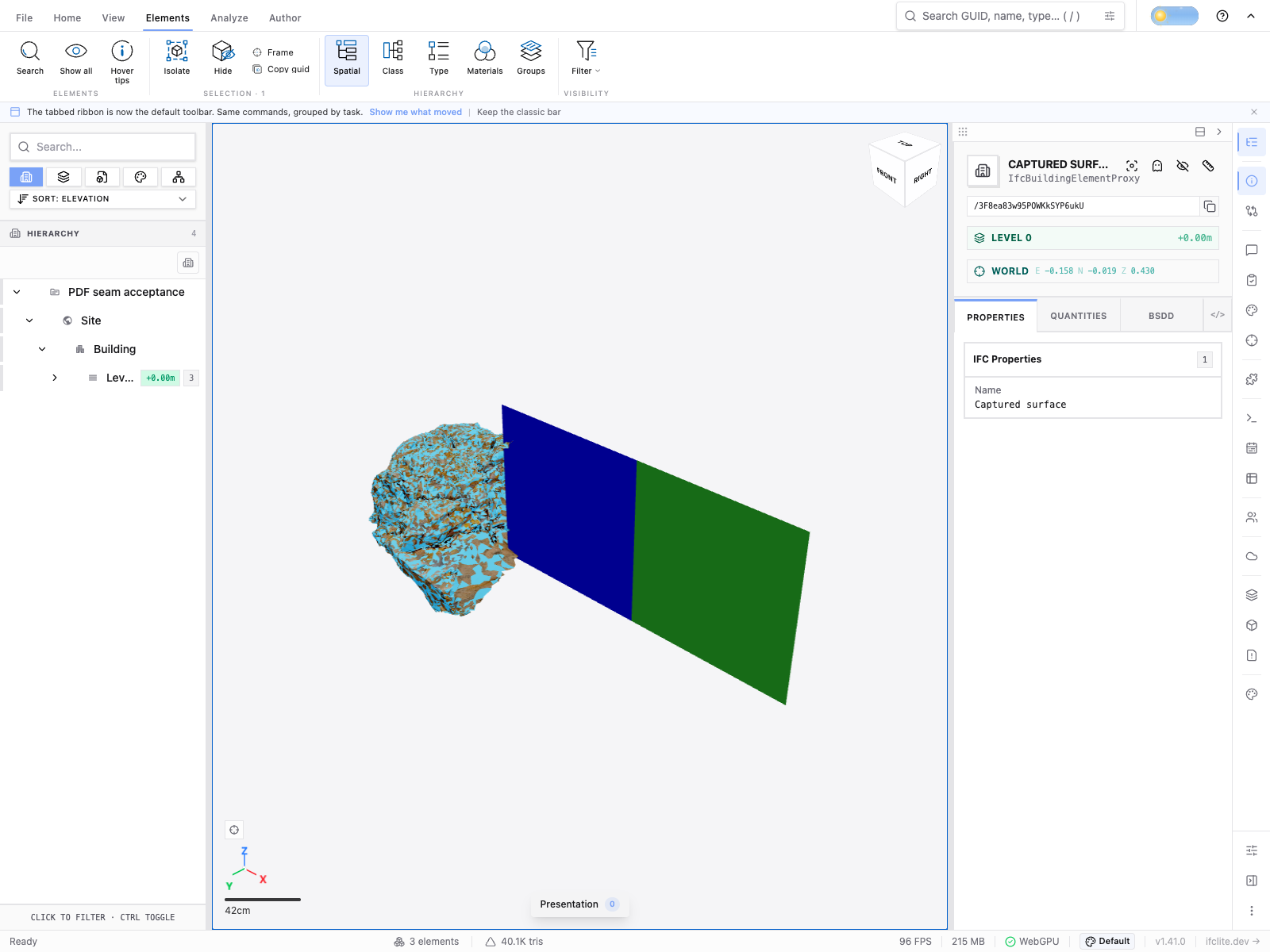
Additional screenshots: owner, fresh guest, and room export reopened and selected. The cyan coverage is the viewer's selection highlight; the unselected image above shows its albedo.
Raw snapshots, the executable temporary harness and downloaded IFCX remain under
/tmp/capture-room-acceptance. Large model/mesh/pixel fixtures are not committed.
This acceptance concerns existing captured-mesh IFC creation and portable sharing;
it does not establish scan-to-BIM semantic inference or scan registration accuracy.
Selected-subset IFCZIP
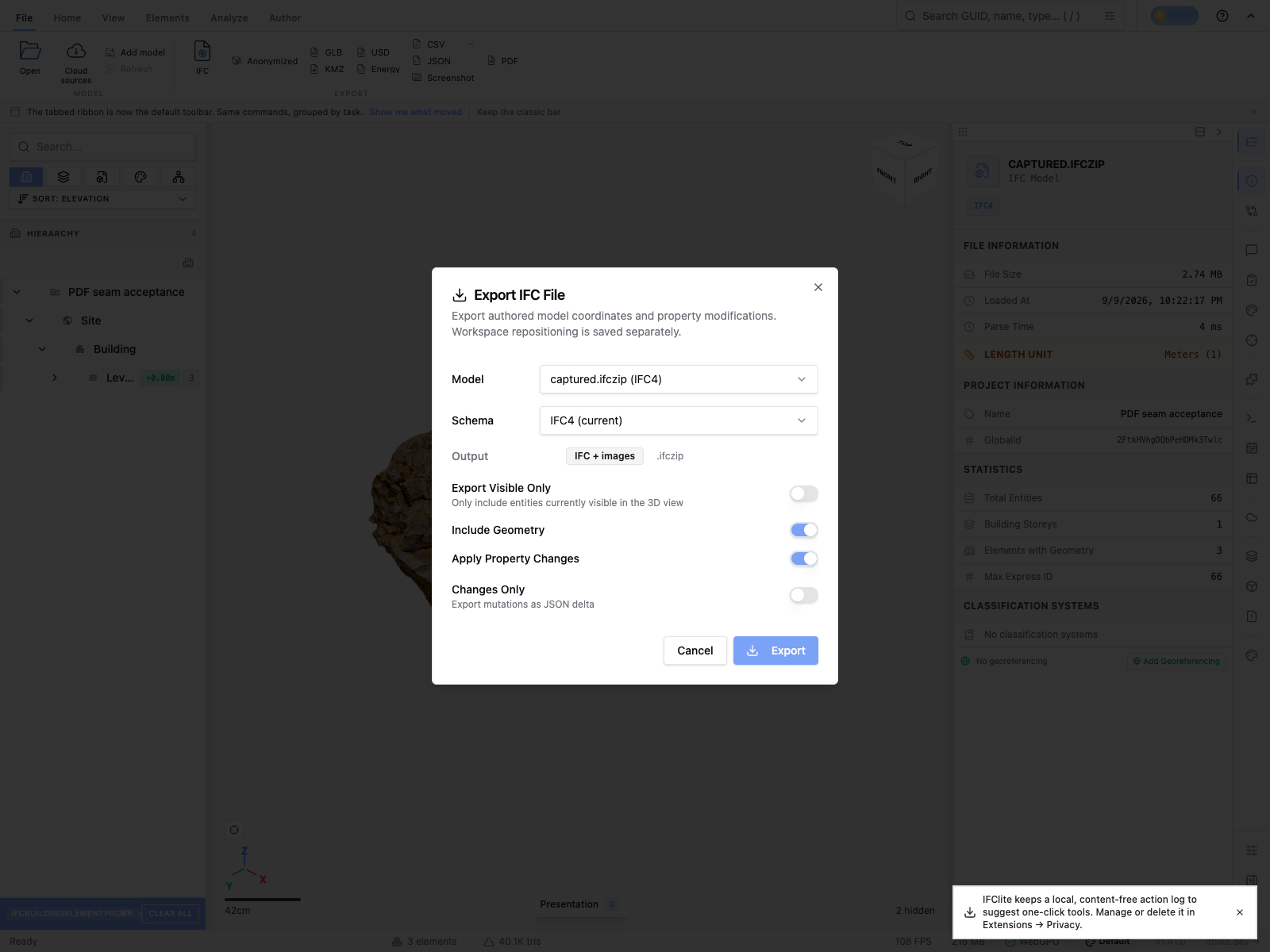
The selected-only exit was verified using the existing ordinary UI: actual mouse selection of the captured proxy, Isolate, then the export dialog's Export Visible Only switch. There is no “Selected objects only” option in this dialog; the evidence describes the controls actually exercised. No hidden store mutation or alternate export API produced the subset.
Subset results record a fresh-context ordinary reopen with
exactly one textured mesh and 40,087 triangles. All oriented world/UV corners match
the full input with zero error; repeat S/T and decoded image identity remain.
A normal mouse click selects that imported IfcBuildingElementProxy again.
Independent IfcOpenShell 0.8.2 reopening finds
41 IFC entities: one building element, zero walls, and the necessary project,
site, building and storey. The proxy retains its GlobalId and Name Captured
surface, ObjectType=IfcLite:CapturedSurface and PredefinedType=USERDEFINED.
Its single containment relationship contains only that proxy and targets storey
Level 0. Independent world-coordinate tessellation also produces 40,087 triangles.
This is a targeted subset/containment check, not blanket EXPRESS-rule validation.
The subset packages exactly one image. All 987,467 original JPEG bytes match the
full input IFCZIP directly; the digest remains
c38f0e918f6dc16b8d386ba3cdd89805c78320c119a1ceec85856f82b09a65b8.
The artifact /tmp/capture-subset-acceptance/captured-proxy-subset.ifczip is kept
separate from the ordinary full export. All temporary contexts and the port-4369
viewer were stopped after the run.
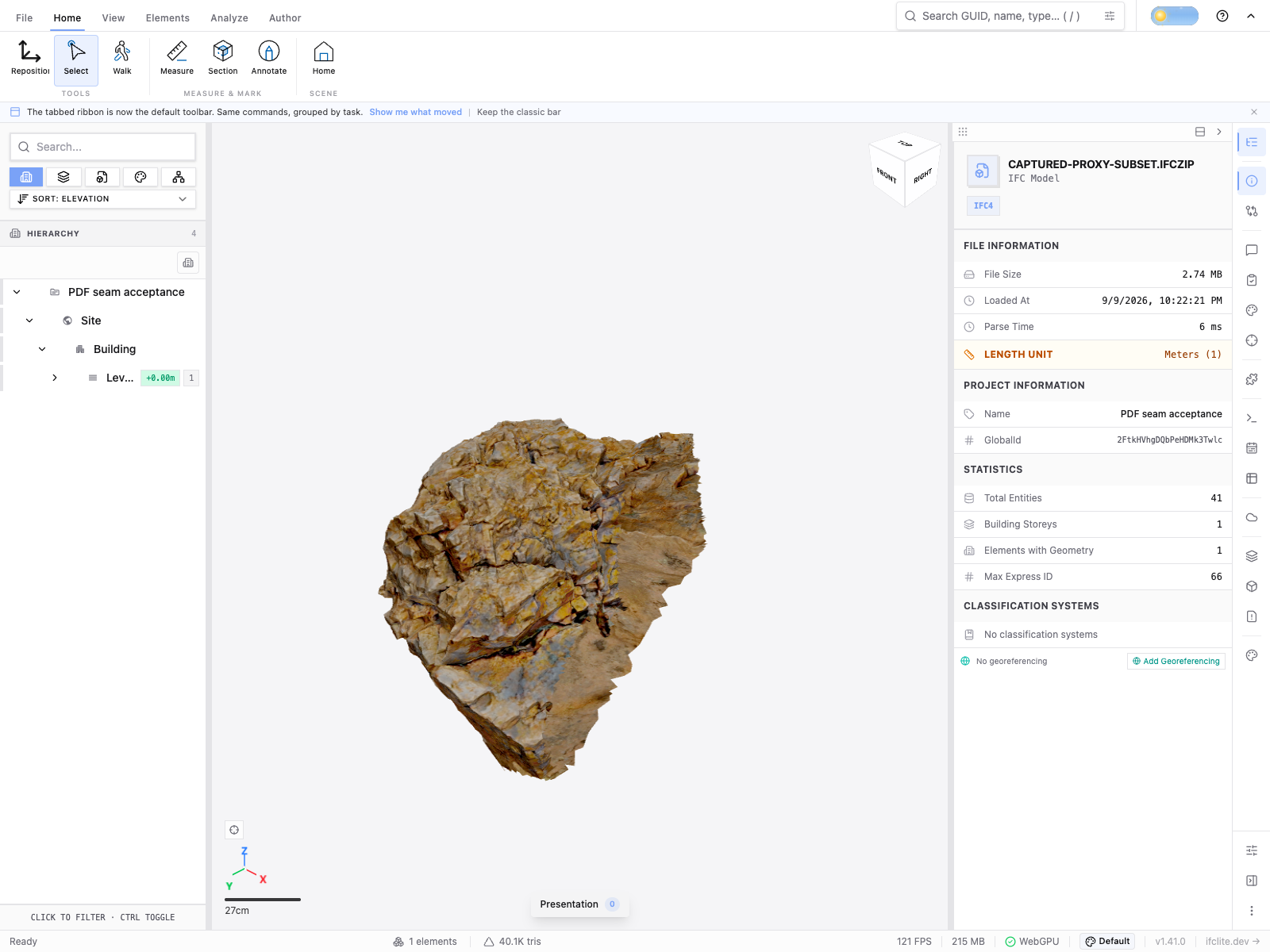
Screenshots also show the ordinary export options and actual imported proxy selection.